He Cut Up Dad’s Bike for This
Braking Mechanism
The registration form had a line for braking mechanism and Maya wrote nothing there, then erased the tail of the M she’d started spelling out in her own name, then closed the notebook and slid it under her math folder where Leo wouldn’t see it. This was a Tuesday. She could hear him in the kitchen making the loud kind of quesadilla, the one where he burned the tortilla and scraped it off and started over, and she thought about telling him she wasn’t racing and decided not to. There was no reason to. He’d forget to ask.
He didn’t forget to ask. He came into her room around nine looking for the phone charger that lived in his own room, saw the corner of the notebook sticking out, and pulled it free. She said hey. He said one second. He flipped to the page with the car on it, the cherry-red coupe she’d drawn maybe forty times, each one a little different from the last, the newest with the wheel wells shaded so hard in pencil the paper had gone shiny.
“You didn’t sign up,” he said.
“The brakes are foot pedals.” She was doing something on her tablet and didn’t look up. “You have to work the pedals. I can’t work the pedals.”
He stood there holding the notebook. She waited for him to say some encouraging thing, the kind their mom said, and he didn’t say anything at all. He just took the notebook with him when he left, which annoyed her, because it was hers.
Three Days
What she knew about the next three days she mostly knew from sound. His garage was under her room. There was sawing, which she’d expected, and a lot of swearing, which she’d also expected, and long flat stretches of nothing where she figured he’d quit, and then the sawing would start up again. He had four classic rock songs on a loop off a speaker with a dying battery, so they kept slowing down and warping and then snapping back when he plugged it in. Their dad went out twice to see what he was up to and came back both times saying only, “He’s got it handled,” in the voice he used when he didn’t fully believe a thing but had decided not to fight it.
Maya went down once, Thursday, late, when she couldn’t sleep. Leo had cardboard taped over the garage window, which was such a Leo thing to do that she nearly laughed. She knocked on the side door and he cracked it open, and behind him she could see the frame of something up on sawhorses, and a bike hanging upside down from the ceiling hook with its back wheel gone and its brake cables cut and dangling like something that had been gutted.
“Is that Dad’s mountain bike,” she said.
“It was Dad’s mountain bike.”
“He’s going to be so mad.”
“Go to bed,” Leo said, not meanly, and shut the door.
Race Morning
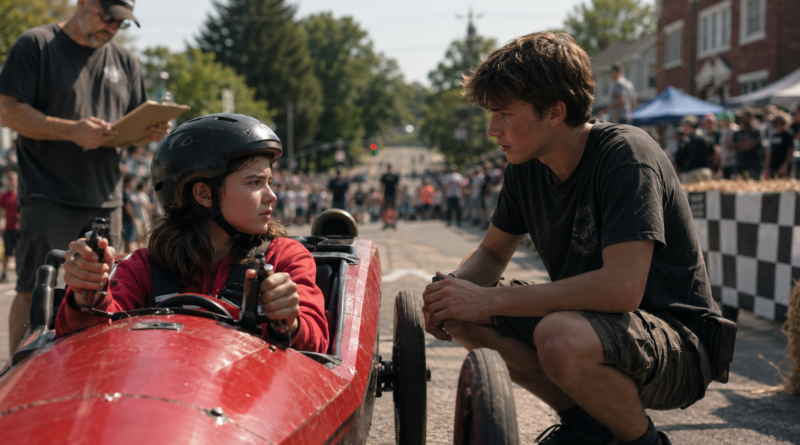
What came out of the garage Saturday was not the car in her notebook. It was rougher than that. The red was good — he’d found real automotive paint somewhere and laid down three coats, she’d learn later, sleeping four hours total across the whole stretch — but the body panels didn’t quite line up, and there was a run in the clearcoat down the left side where it had dripped and dried before he caught it. He’d left it. He told her he was leaving it, because sanding it back meant repainting the whole panel and the race was in two hours.
What mattered was the cockpit. Where the pedals should have been there was a bare footwell and a block of foam. Bolted to the steering column were two levers off the mountain bike’s brake handles, wrapped in bar tape because the original grips had cracked. He’d run the cables back to the rear axle. Pull the levers, the pads bit the wheels. Push them forward, you rolled. You steered with the same wheel your hands were already holding. He’d worked it out so she never had to let go of anything.
He lifted her into the seat. This was the part that in a different telling would be the part with the music, and there was a moment where her throat did something and her eyes stung — and then it passed, because the helmet strap was pinching the skin under her chin and she had to tell him and he had to fix it, and by the time it was fixed she wasn’t crying, she was just annoyed about the strap. He crouched by the wheel and made her pull the levers ten times so he could watch the pads. On the eighth pull he frowned and tightened something with an Allen key out of his pocket. He had about six Allen keys distributed across his pockets. He’d been living in those cargo shorts for three days.
Officials
Two men at the registration table did not know what to do with her. One of them, a dad named Rick who ran the hardware store and took the derby more seriously than the town did, kept working the levers with his own hand and saying he wasn’t sure this met the spec. Spec said foot-actuated braking. This was not foot-actuated braking.
Leo didn’t argue with him about fairness or inclusion or any of the things Maya had braced for. He argued stopping distance. He got Rick to roll the car ten feet on the flat and yank the hand lever, and it stopped dead, and then Leo said, “Do that with a pedal car going eight.” Rick, to his credit, thought about it. He conferred with the other guy. He made Leo demonstrate it twice more. Then he wrote something on the clipboard and said she could run in the exhibition slot, last, and if the brakes did anything weird she was pulling off the course, no arguments. Leo said fine. Maya said fine. Rick still looked unhappy, which she understood later was just his face.
Hill
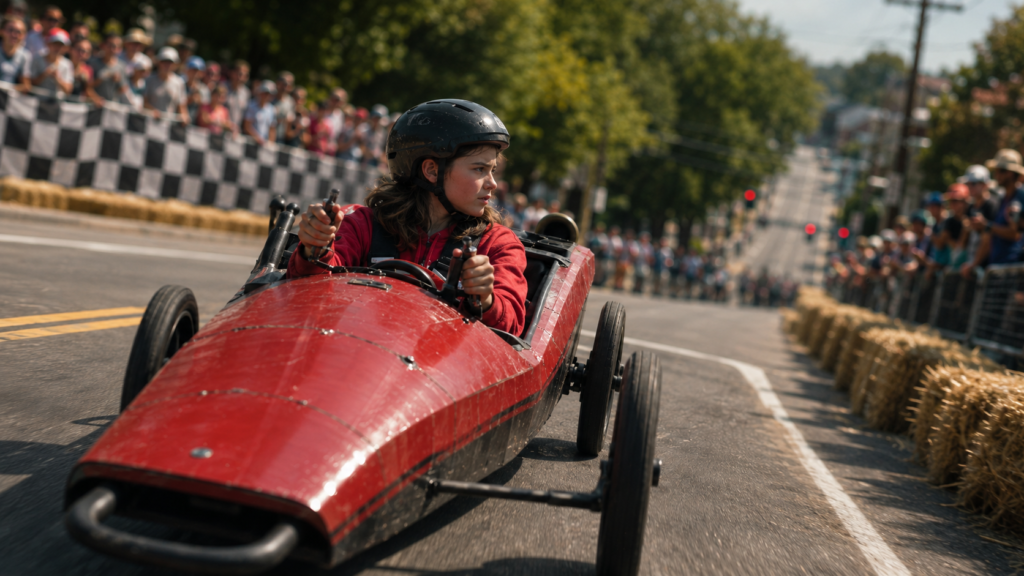
At the top of Elm the starter counted her down and she pushed the levers and the car went, and that was it, that was the whole thing she’d wanted since March. It was loud in a way she hadn’t expected, the wheels on the asphalt right there under her, a hard rushing rumble coming up through the seat. She took the first curve too wide and had to haul the wheel over and feather the left lever, and the back end chattered and held. Her hands did the work. Her hands were the only part of her that had ever really worked the way she wanted them to, and now they were driving a car down a hill, and she thought, off to the side of her own attention while she was doing it, that she’d remember the chatter of that back wheel longer than she’d remember any of the rest of it.
She did not win. A kid named Devon Pruitt in a plain plywood wedge with no paint and no story beat her by most of a second, because his car was lighter and he took the racing line and she took the line of a person braking into every corner because it was her first run and she liked being able to stop. Second in her heat. The crowd made noise at the bottom, real noise, but she’d lost the ability to tell how much of it was for the car and how much was just for the fact of her being in it, and she found she didn’t want to know.
After
They gave her a trophy at the folding table by the snacks, a spirit-type trophy, the kind everybody understands is not the speed one. She held it and said thank you to the mayor, who she was fairly sure didn’t actually know her name and got it right anyway because Leo had told the guy at the mic. Leo stood off to the side eating a hot dog with the total focus of someone who hadn’t had a real meal in three days. Somebody’s mom asked him if he’d build one for her son. He said he’d have to see the kid’s chair first, mouth full, not really committing to it.
Maya wanted a hot dog too. She caught Leo’s eye and pointed at his and held up one finger, and he nodded and started toward the stand, and then Rick from the hardware store came over to look at the brakes again, still frowning, still turning the levers, and Leo got pulled into explaining the cable routing, so the hot dog didn’t happen right away.
“They put mustard on it,” she called after him. “Don’t let them put mustard on it.”
He raised a hand to say he’d heard her, or to say something, and kept talking to Rick about the axle.
