He Strapped a Camera to the Dog
Platform 3
The dog showed up at six and Carter noticed it the way you notice a stain on the ceiling — not all at once, just the same thing in the same spot enough nights running that eventually you’re looking at it on purpose. Golden, or it had been golden under the dirt. It sat at the far end of Platform 3, past where the shelter roof stopped, so it took the snow directly, and it didn’t shiver the way Carter thought a dog should. It just sat and watched the tracks toward the tunnel like there was something coming it wanted to be ready for.
Carter ran the station overnight, which mostly meant he was the person there when things went wrong and the person there when nothing did, and nothing did, most nights. He had time to watch a dog. He started keeping a granola bar in his coat, then a can of the wet food from the pharmacy near his apartment, which he opened and set down at a distance the first few nights before he understood the dog wasn’t going to eat while he watched. He’d come back and the can would be clean, licked into the corner of the platform, and the dog would be gone, because by then the last train had run, and the dog left when the last train ran. Every night. It left at the same time it would’ve left if it were meeting someone off that train and the someone hadn’t come.
He told his wife about it. She said bring it home. He said it wouldn’t come, he’d tried, it backed off every time he got past a certain distance, polite about it but firm, like a person declining a second drink. She said try harder. He said he was working on it.
Camera
His brother-in-law had a little action camera with a strap mount, bought for a kayaking trip and used once. Carter borrowed it and didn’t fully explain why. He had some idea the dog was going somewhere, and another idea, one he didn’t say out loud even to himself, that wherever it went would explain the sitting and the watching and the not-shivering, and that the explanation would be sad, because the setup was sad — a dog alone in the snow waiting on a train. He’d more or less already written the ending. He figured a dead owner. He figured the dog had come off that train once, with somebody, and the somebody was gone and the dog kept the appointment anyway. He’d worked himself into being a little upset about it in advance.
Getting the strap on took four nights. The dog let him get close, then closer, then on the fifth night let him kneel down beside it and clip the mount to the collar, which was a real collar, worn, no tag, which told Carter something though he wasn’t sure what. The dog looked at him while he did it. Not soulfully. Carter would’ve said soulfully if you’d asked him before, but up close it was just a dog watching a person do something to its neck, patient about it, waiting for the person to finish so it could go.
Then the last train ran and the dog got up and left, and the camera went with it.
Footage
He watched it the next morning in the back office with the space heater on and his coffee going cold, which he didn’t notice going cold until he drank it and it was cold. The file was forty minutes. The dog left the platform and the frame bounced — that hard low bobbing of a camera strapped to something that trots — and went down the station steps and out into the street, and Carter watched Oak Creek go by in an upside-down jostle at dog height, plowed snowbanks and parked cars and the salt-stained bottom six inches of everything. The dog stopped at a crosswalk. Actually stopped, sat down, then went. Carter didn’t know what to do with that.
It went maybe half a mile, and then the camera tilted up and there was the hospital. Pinecrest. The kids’ one, that brick pile off Route 9 with the lit-up sign. The dog went around the side, through a gap in the hedges it clearly knew, across a strip of garden, and put its paws up on a window ledge, and the camera steadied for the first time in the whole file because the dog was finally holding still.
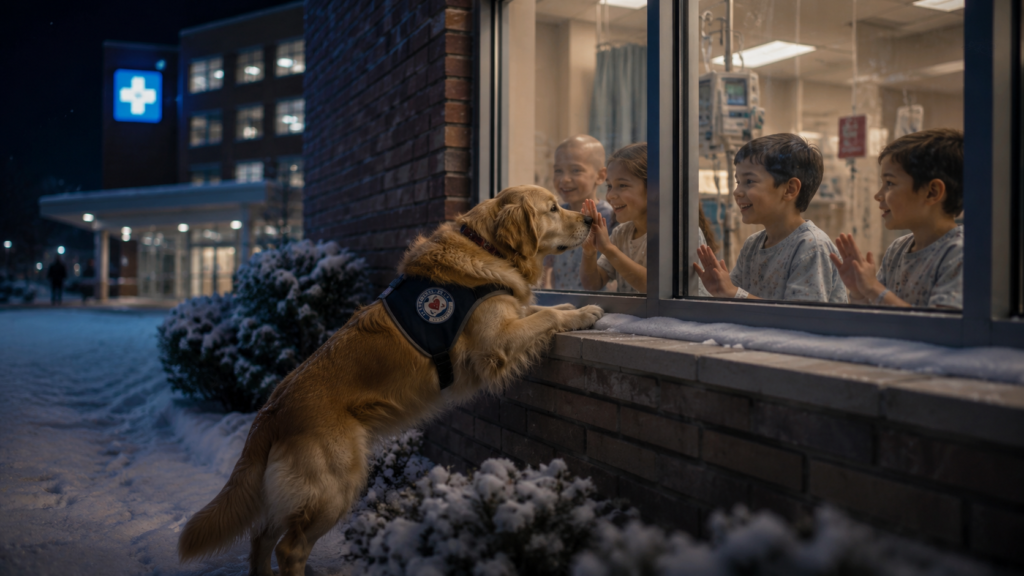
There were kids inside. Three, four of them, in gowns, one with a bald head and one with a tube taped to her cheek, and when the dog got to the window their faces did a thing Carter watched twice and then a third time. They lit up. He didn’t have a better word for it and didn’t try for one. Small hands came up on the glass, and the dog’s nose fogged the glass from the outside, and its tail was going, you could tell from the way the whole frame swung, and this went on a while. Six, seven minutes. Then a nurse came into the frame inside and the kids didn’t want to go and went anyway, and the dog dropped off the ledge and the camera dropped with it and started bobbing again, and the dog went home. To the platform. Where Carter found it that morning with the camera still on its collar, sitting, watching the tracks, waiting for six o’clock so it could do the whole thing over.
That chime was the part that got him, once he worked it out. The clock tower rang at six, loud enough to hear halfway across town. The dog wasn’t waiting for a train. It was waiting for the bell. The bell meant it was time to go see the kids. It had a job and it was early for it every single day.
Chloe
He called the hospital that morning before he’d even slept, which was a mistake — he wasn’t making sense, and the person on the phone took a while to route him to someone who’d listen. That was Chloe, who ran the pediatric floor and had, it turned out, been wondering for months about the dog the night kids kept mentioning, the window dog, which the day staff had filed under kids-say-things until enough kids said it.
He drove the camera over. They watched it in a break room that smelled like microwave popcorn. Chloe watched the window part without saying anything, then said, “That’s the Reyes girl’s whole week, right there. She talks about that dog more than she talks about going home.” She didn’t get weepy about it. She was a person who’d clearly used up a lifetime supply of getting weepy about things in that building and had learned to spend what was left carefully. She just said they should figure out how to not have him doing this through a window in February.
It was not simple. It took weeks. There was a vet check and a question of who owned the dog, legally, which was nobody, and there was liability, and there was the fact that a stray off a train platform is not automatically a therapy animal no matter how good its attendance record. There was training. There was a behaviorist named Dale who was skeptical and then wasn’t. Carter did a lot of this on his days off, and his wife stopped telling him to bring the dog home, because the dog was, in a slower and more bureaucratic way, coming home to the place it had already picked.
Barnaby
They named him Barnaby, which wasn’t Carter’s idea, and which he thought was a slightly ridiculous name, and which stuck immediately and completely. It came off a list the child life staff put in front of the Reyes girl and two others, and they voted, and Barnaby beat out Rocket and Sir Barks, and that was that. Carter would’ve called him something plainer but nobody asked Carter.
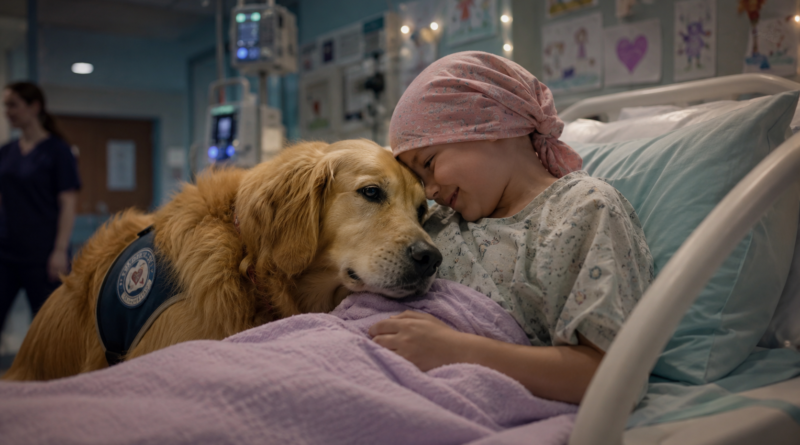
He passed the certification in the spring. He stopped coming to the platform, obviously, because he lived at the hospital now — spent his working evenings there and his nights in a foster placement two blocks away that was on track to become permanent. Carter went by the pediatric floor once to see it. They let him up. Barnaby was on a low bench with the Reyes girl half-asleep against his side and a second kid working a brush through the fur on his back, not gently, and Barnaby was taking it with the exact patient waiting-to-be-finished look he’d had on the platform the night Carter clipped the camera to his neck.
The girl brushing him asked Carter if he was the dog’s dad. Carter said not really, he just found him. She said okay and went back to brushing. Barnaby’s tail thumped the bench twice when Carter said his name and then stopped, because the girl had hit a knot and it needed his attention more.
Carter stood there another minute. Then a nurse said visiting the floor was really for families, and he said sure, no problem, and took the stairs back down and got in his car. The heater took a while to come on. He sat in the lot with his hands on the wheel waiting for it, watching the lit windows, and then the warm air came through and he backed out and drove to work.
