What the Old Watch Did Instead
Repair
The card reader at the sandwich place wouldn’t take Harrison’s watch. He held his wrist over the terminal a second time and the girl behind the counter watched him do it, and behind him a man in a wet coat shifted his weight and sighed, and the tap didn’t go through. Harrison looked at the screen. Dark. He pressed the crown on the side, the way you press an elevator button that’s already lit, twice, three times, as if the machine could be shamed into working.
“You got a card?” the girl said.
He had a card somewhere. He dug it out of the back of his wallet, a corporate Amex he hadn’t touched in months because the watch did everything now, and the strip was scratched and it took two swipes. The man behind him sighed again. Harrison took his ham baguette in its paper sleeve and stepped out of the line and stood on the sidewalk in the drizzle and tried the watch one more time, holding the button down until his thumb went white.
Nothing. His own face in the black glass, stretched sideways.
He had a signing at three. A contract that had taken since February to put together, four firms, two languages, a room booked on the top floor of a building on the rue de la Paix with a view he wouldn’t look at. The address was in the watch. The time was in the watch. The confirmation from the notaire, the car he’d booked, the reminder he’d set to call Claire’s sister back about the thing he’d already forgotten — all of it in the watch, which now told him nothing, which now told him it was a small black rectangle strapped to his arm with a rubber band.
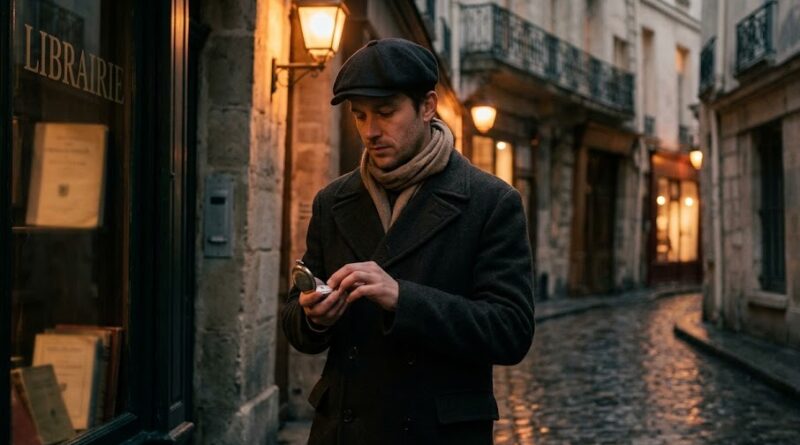
He walked. He didn’t know exactly where he was going but he knew the general direction and he figured he’d find a place that fixed phones, one of those counters with the cracked screens taped to the wall and a guy in the back with a heat gun. What he found instead, two streets off the main drag, down a narrow lane where the cobbles were slick and the gutters ran, was a shopfront with LIBRAIRIE painted in gold across the top, half the letters gone to flaking, and under that in the window a hand-lettered card: Horloger — réparations.
Inside
A bell rang when he pushed the door. Warm in there, and dim, one lamp burning over a bench and the rest of the room in shadow, shelves going up into the dark stacked with books and clock parts and boxes. It smelled like oil and old paper and something else, dust maybe, the smell of a room that didn’t get aired out.
An old man sat at the bench with a loupe pushed up on his forehead and a rag in one hand, working at a pocket watch, turning it in the light, rubbing polish into the silver. He didn’t look up right away. He finished the turn he was making, set the watch down on a square of felt, and then looked up.
“Something broken,” he said. Not a question.
Harrison unstrapped the watch and set it on the bench between them. “It died on me. Won’t turn on. I’ve got a — I need it back by three.”
The old man picked it up. He didn’t tilt it or study it or do any of the things Harrison expected. He turned it over, looked at the back, pressed the crown once the way Harrison had, and set it down.
“The battery’s not the problem,” he said. “It’s the board. I’ve seen a few of these. When the board goes there’s nothing to do but replace the whole works.” He shrugged, one shoulder. “I can’t get the part here. You’d order it from them, from the company. A week, maybe more.”
“A week.” Harrison heard the number come out of him flat. “No. That doesn’t work. Everything’s on there. My whole schedule. I’ve got a signing in” — he looked at his wrist, at the pale band of skin, and stopped — “I don’t even know what time it is.”
The old man reached up and pulled a real clock down off the shelf behind him and turned it around. Twenty past one.
“Twenty past one,” he said, as if Harrison hadn’t seen it.
Harrison stood there. The address he could get from his email if he found a computer, or he could call his assistant, except his assistant’s number was in the watch. He could feel the afternoon coming apart in his hands.
The watchmaker was looking at him. Then he reached over to the far corner of the bench, past the tools, and picked up the pocket watch he’d been polishing when Harrison came in. He held it out.
“Take this,” he said. “It’s not for sale, it’s mine, but you can carry it a few days. It won’t ring. It won’t tell you the weather or count anything.” He clicked it open with his thumb. The face was plain, white, black numbers. “It tells the time. That’s all it does. You’ll find it’s enough to be getting on with.”
Harrison looked at it. It was the last thing he wanted, a hundred-year-old watch on a chain, the kind of thing his grandfather might have carried, dead weight in a suit that cost more than the watch. But he had a signing at three and no way to check the time, and the man was holding it out, and it would have been strange to say no.
He took it. It was heavier than he thought. Cold in his palm, dense, the chain thin as thread and silver, pooling into his hand when he lifted it. He put it in his coat pocket and it hung there, a real weight, pulling the coat down a little on that side.
“Three o’clock,” the old man said. “You’ve time. It’s not far, wherever it is.”
Three Days
The first day he checked it constantly. Every few minutes his hand went to his pocket and drew it out and clicked it open, and half the time he’d just looked and didn’t even register the number, closed it, put it back, and thirty seconds later his hand was going for it again. His wrist felt naked. He kept glancing at it, at the strip of paler skin, expecting the buzz, and there was no buzz, and the not-buzzing was its own kind of noise.
The signing went fine. He got there on time. He sat in the room on the top floor with the view he didn’t look at and he signed where they told him to sign and shook the hands he was meant to shake, and the whole time some part of him was aware of the watch in his pocket, the fact of not being reachable, the low hum of it that he couldn’t tell was panic or something else.
Second day was worse in the morning and then, oddly, not. He stopped reaching for the watch quite so often. He noticed at one point he’d gone most of an hour without checking anything at all, and the noticing almost undid it, made him reach for it again just to have reached.
The Métro
Third day, Line 1, heading east in the late part of the afternoon. The car was half full. He had the watch out, already checked, nothing to check, and nothing on his wrist, and so he did the thing he almost never did on the Métro, which was look up.
Across the car an old couple sat side by side. The woman had her hand tucked into the man’s on the seat between them and neither of them was talking, and neither of them was looking at anything in particular, they were just there, riding, going wherever they were going. He watched them without meaning to. Somebody’s grocery bag leaned against the pole, a baguette sticking out the top of it. A kid two seats down was kicking the base of the seat in front of him, steady, bored, and his mother said something to him and he stopped and then started again.
The train came up out of the tunnel onto the stretch where the line runs above ground for a while, and the light was doing the thing the evening light does in that city, coming in low and gold across the fronts of the buildings and off the river, and he sat there and watched it go by. He’d taken this line a thousand times. He’d never once seen this.
His stop came and he almost missed it.
He Asked
He got home that night and stood in the hall taking his coat off, the watch heavy in the pocket, and instead of going down the hall to the room he used as an office — which his feet knew the way to, which they turned toward on their own — he went into the kitchen.
Claire was at the counter. She had a glass of wine and she was doing something with a stack of mail, sorting it, and she looked up when he came in and there was a beat where he saw her clock the fact that he was in the kitchen, not the office.
“Hey,” she said.
“Hey.” He pulled a stool out and sat down at the counter, on the corner of it, near her. He didn’t have his watch to check. His hands didn’t have anything to do so he put them flat on the counter.
“How was your day,” he said.
She looked at him for a second. Something crossed her face, and he understood, in a way that was not comfortable, that it had been a while since he’d asked her that and meant it, had asked it and then stayed in the room to hear the answer. She set the wine down.
She told him. Some problem at work, a colleague who’d taken credit for a thing, and then her sister, and then something about the upstairs neighbor and the leak, and it wasn’t a speech, it was just the ordinary rundown of a day, and he sat there and listened to all of it and didn’t drift and wasn’t anywhere else. At one point she stopped and said, “You’re being weird,” and he said, “My watch broke,” and she looked at him like that didn’t explain anything, which it didn’t, and she kept going.
Here’s the thing he wrote down later, on the back of an envelope, a kind of list, though he wasn’t a man who made lists:
- The sandwich under the office is actually good.
- Claire’s sister’s name is Margot and she’s getting divorced and I did not know either of those things.
- The neighbor’s leak has been going on for three weeks.
- I have walked past a bakery every morning for two years and never smelled it.
He wasn’t sure why he wrote it. He put the envelope in a drawer.
The Week
Seven days out he went back down the lane and the bell rang and the old man was at the bench, loupe down, bent over the works of a mantel clock with a pair of tweezers.
“It came,” the watchmaker said. He set the tweezers down and reached under the bench and brought out the smartwatch, the band coiled around it, and put it on the felt. He’d charged it. Harrison touched it and the screen came up white and clean, and then the notifications started, the little numbers stacking in their red circles, a week of the world arriving all at once, and it kept going, the count climbing while he watched.
Harrison took the pocket watch out of his coat. It was dull now, a week of his thumb on the silver, warm from his pocket. He set it on the bench next to the other one, the dead old thing and the live one side by side, one counting and one just sitting there.
“What do I owe you,” he said. “For the repair.”
The old man told him. Harrison paid it. Then he stood there and neither watch moved and he looked at the two of them.
“And this one.” He put a finger on the pocket watch. “You said it wasn’t for sale. What would it take.”
The watchmaker looked at him a while. Then he picked the pocket watch up and turned it over in his fingers and named a figure, and it was more than fair, it was low, and Harrison didn’t argue it up the way part of him wanted to. He put the cash on the bench.
He left the smartwatch there. He didn’t decide to, exactly. He picked up the pocket watch and put it in his pocket and the smartwatch was still on the felt lighting up and counting and he just — didn’t pick it up. The old man watched him do it and didn’t say anything and didn’t push it back across the bench.
Out in the lane the rain had quit. The cobbles were still wet and the light was coming on in the windows up and down the street. He got the watch out and wound it a few turns, the way the man had shown him, thumb and finger on the little crown, and he held it up to his ear and stood there in the wet street a second, listening to it go, that small dry sound, tick tick tick, before he closed his hand around it and went to find the stairs down.
