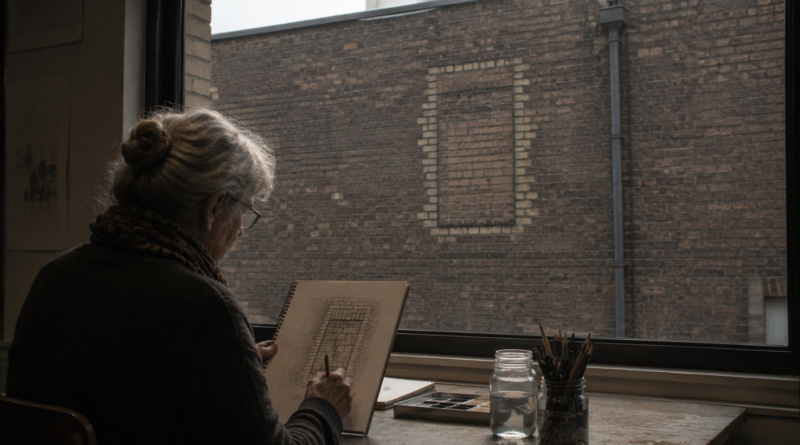
Eight Drawings of the Same Wall
Lenora signed up for the drawing class because the mornings had gotten long and the evenings were worse. She told people other things — that she’d always meant to try it, that a friend had recommended it — but the true reason was that retirement had turned out to be a lot of hours in a quiet apartment, and the quiet she’d spent forty years wanting was both exactly right and somehow not enough. She wanted a reason to put her coat on. So when the flyer went up at the library, eight weeks, no experience needed, she wrote her name at the bottom before the sensible part of her could weigh in.
She was sixty-two and had never thought of herself as an artist, and walking into the room that first night among eleven strangers she still didn’t. Some of them plainly knew what they were doing. A couple had their own supplies in worn cases. Lenora had a sketchbook stiff from the shop and a packet of pencils and no real idea how you were meant to hold one.
Choose a Window
The instructor was a quiet man who didn’t waste time on a speech. He gave them the assignment almost before they’d sat down.
“Pick a window,” he said. “Any window in the building. Draw what’s out it. That’s the whole thing.”
There was a small polite scramble, the way people move when they sense the good options are finite. Lenora had never in her life been quick to grab, so she let them go.
One took the window over the little park — greens, benches, a fountain. One took the street side, all traffic and movement. A third settled in front of a clean view of a church tower against the sky, pleased with himself.
By the time she crossed the room, one window was left, in the far corner. She drew the curtain back to see what she’d been handed.
Five feet away stood the blank brick side of the building next door.
No trees. No people. A gray sliver of sky right at the top and nothing else — just brick, brown and flat and close enough to touch. She had, no argument, drawn the worst view in the building. She thought about asking to move, and then thought that complaining on the first night was a poor way to start, and sat down and opened the stiff book and drew the wall.
The First One
It came out exactly as dull as she’d expected. Rows of brown brick. The mortar lines. A drainpipe down one side. She rendered it carefully and got no pleasure from it and finished well before anybody else, then sat the rest of the hour wondering what the others were seeing out their better windows.
She assumed next week would bring something new. Instead he told them to go back to the same windows.
She nearly spoke up. Got as far as opening her mouth. But she went to her corner and pulled the curtain, resigned to another flat hour, and was sitting there when, around six, the thing happened.
The sun came down the gap.
Dropping behind the buildings somewhere, it found the narrow slot between them, and for a few minutes light slid into the alley and struck a thin vertical band of the wall, and maybe twenty ordinary bricks went a deep glowing orange. Not brown — orange, lit hard from the side, every ridge and pock thrown into relief. She watched it. Four minutes, five. Then the light climbed away and the bricks went back to brown.
She drew that instead. The strip of fire down the middle of the wall.
Learning the Wall
The third week she saw something she’d have sworn wasn’t there before, though of course it had always been there and she just hadn’t looked hard enough. There had once been a window in that wall. Someone had bricked it up a long time ago, but the ghost of it held if you knew to look — the fill brick a slightly different size, a slightly different shade, laid by another hand in another year. A rectangle of a window that no longer existed, sitting in the wall like a scar. She spent the whole class on the shape of it and left that night moved by something she couldn’t have put a name to.
After that the wall kept handing her things. One week it rained and the brick darkened in blotches as the water went in, some patches near black and some still dry, a map of wet and dry shifting while she watched. Another evening a plant no bigger than her thumb was growing out of a crack at the base of the drainpipe, a small stubborn thing that had found a hold in the one place nothing ought to grow.
Nothing dramatic ever happened to the wall. No one ever came to it. It didn’t change in any way that counted. And still, week on week, it stopped being one thing and became a hundred, depending on when she looked and how.
Everywhere Else
Somewhere in those weeks something shifted that had almost nothing to do with drawing. She started noticing things elsewhere.
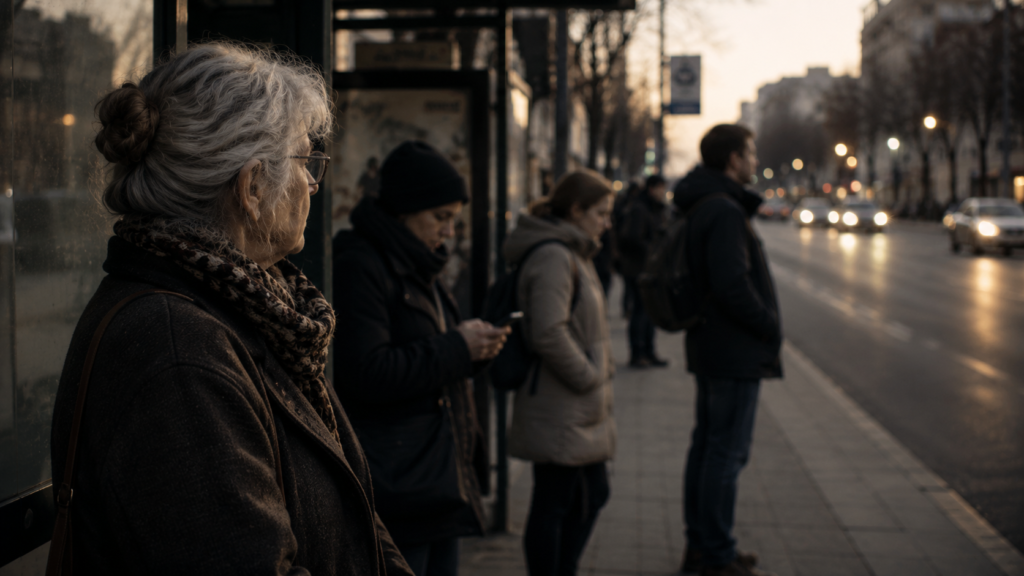
At the bus stop she caught herself watching how people’s bodies changed when they’d begun to suspect the bus was late — the small sag, the checking of phones, the drift toward the curb to peer down the road. At the supermarket she saw that one fluorescent tube over the cereal ran a little warmer than the rest, a little wrong, and that she’d walked under it a hundred times without seeing it. She saw the worn hollows in the stairs of her building and understood all at once that everyone for decades had put their foot on nearly the same spot on every step, wearing the stone into the shape of a thousand identical trips.
None of it was important. That, she came to see slowly, was the entire pleasure of it. Most of her life she’d moved through the world by working out what a thing was for and then not seeing it anymore. A door was a way through. A bus was a way there. Now she found herself looking at things she’d already identified, and it turned out there was so much sitting there, in the part everyone skips.
The Exhibition
On the last evening the class put up a small show. Each student was to hang one piece.
Lenora asked if she could use eight.
The instructor looked at her a moment, then gave her a section of wall to herself, and she hung all eight in a row, left to right, in order. The first competent and dead — brown brick, mortar, drainpipe. The second with the band of evening light burning across it. The third the outline of the sealed window. The fourth really a study of rain. The fifth built on the long line of the pipe. The sixth with room for the small plant. And by the eighth the wall was plainly still the same wall — same brick, same pipe, same rectangle where a window used to be — and the drawing looked almost nothing like the first.
People stopped in front of the row longer than she’d expected, moving along it slowly, the way you move through a story.
After a while the instructor came and stood next to her, looking from the first to the last and back.
“Did the wall change that much,” he said.
She looked at the eight pictures. “No. I got better at looking.”
He nodded. That was all, and she was glad he left it there.
Afterward everyone packed up. She said her goodbyes, put her coat on, and got half a block toward the stop before she realized she’d left her scarf. She went back. The room was mostly dark now, the others gone, her eight still hung on the show wall — they’d said you could collect your work the following week. Her scarf was over the back of her chair. And because she was there, she drifted to her window one last time.
Outside it was full dark. For the first time in eight weeks there was nothing out there to draw, the wall gone into the night, and she felt a small pang at it.
She was turning to go when the glass caught her. With the dark outside and the last lights behind her, the window had gone quietly to a mirror, and in it was the whole empty room — the chairs, the long tables, the water jars clouded gray and brown, one forgotten pencil under a stool. And on the far wall, backward in the dark glass, her eight drawings of the brick.
Lenora stood looking a while. Then she reached into her bag and took out the small sketchbook and sat down in her usual chair and turned to a clean page. She looked up at the glass, and down at the paper, and worked out where the tables wanted to sit on the page, how much of the room she could get before the light was too far gone to see the pencil. She started the long line of the near table first, because that was the thing closest to her, and the rest would have to build off it.
