My Kitchen Table Seats Four
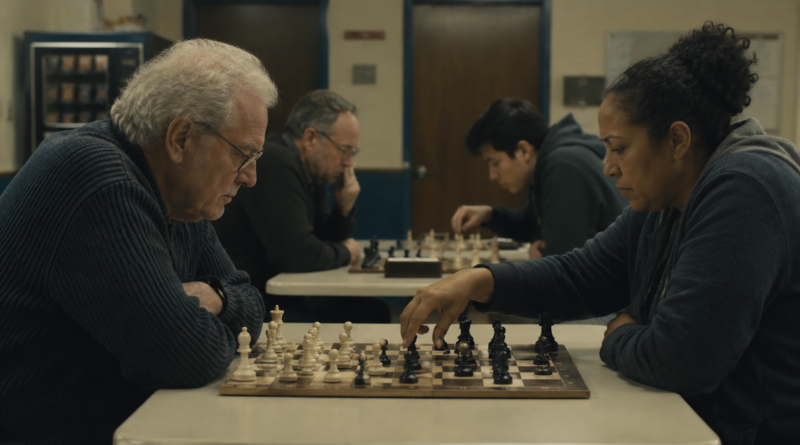
Warren Pike had been losing at chess every Thursday for three years, and he’d made a kind of peace with it.
Not the ordinary kind of losing, either — not the respectable kind where the game hangs in the balance until somebody slips near the end. Warren lost early. He lost predictably. Some nights he lost so completely that whoever sat across from him had to spend the last ten minutes staring at the board and pretending there was still a decision left to make, just to be polite.
He was sixty-seven, and he’d learned the rules at sixty-four, which he considered a perfectly reasonable explanation for all of it. Nobody else did.
“You’ve been doing this for three years,” Keisha said one Thursday, lifting his bishop off the board with a pawn.
“I’ve also been cooking for forty,” Warren said. “You should taste my rice.”
She laughed and reached for the clock.
Room 4B
Thursday chess lived in Room 4B of the Bellweather Community Center, seven until nine. Six folding tables, twelve plastic chairs, a vending machine that took coins only when it felt it had been treated with adequate respect, and overhead fluorescents that gave everyone the complexion of a man recovering from something.
The sign on the door read OPEN CHESS — ALL LEVELS WELCOME. Most weeks “all levels” came out to four people.
There was Warren. There was Keisha Monroe, forty-three, who drove a city bus, played fast, and openly despised anyone who spent five minutes agonizing over a move with one obvious answer. There was Owen Beck, fifty-eight, who worked at an eyeglass shop and cleaned his lenses every time he started losing, which was often enough that his glasses were the cleanest in the building. And there was Rafi Nasser, nineteen, a first-year college student who could beat the other three while eating chips with his free hand.
They weren’t exactly friends. Warren knew which route Keisha drove but had no idea where she lived. He knew Owen had a daughter, because she’d called once during a game. He knew Rafi studied something to do with computers, though every time Rafi tried to explain what, Warren came away understanding less than he’d started with.
They didn’t see each other outside Room 4B. They didn’t call. There was no group chat. They played chess on Thursdays. That was the whole arrangement, and it had suited all four of them fine for three years.
The Notice
The end of it arrived in the person of Lydia from the front desk, who appeared in the doorway at 8:17 one evening while Warren was still trying to reconstruct how Rafi had relieved him of both rooks in six moves.
“Quick thing before everybody heads out.”
“That phrase has never once introduced good news,” Owen said.
Lydia pressed on. “Starting next month, Thursday nights in this room are going to the beginner dance program.”
Keisha looked up. “What happens to chess?”
“You can still play here Monday afternoons.”
“I work Monday afternoons.”
Lydia made an apologetic face. “I know. We just don’t get the numbers on Thursday nights. Dance has twenty-six people registered.”
Warren looked around at the four of them. It was hard to argue with twenty-six.
“Fair enough,” Keisha said.
Rafi tipped back in his chair. “Anywhere else in the building?”
“Not Thursday nights. Sorry.”
Owen was already dropping captured pieces back into the box. “When’s the last one?”
“Three Thursdays from now.”
“All right.”
And that was essentially the whole reaction. Nobody protested. Nobody circulated a petition or accused the center of turning its back on the noble game. Twenty-six people wanted to dance and four people wanted to play chess, and the arithmetic there wasn’t complicated.
Rafi nodded at the board. “By the way. You’re in check.”
Warren looked down. “I don’t like you.”
“You say that every week.”
“Every week you hand me fresh evidence.”
The Last Night
The next two Thursdays went by without anything shifting. Keisha showed up at 7:04 one week to report a passenger had tried to pay bus fare with a Canadian coin. Owen brought salted peanuts and had nearly finished the packet before it occurred to him to offer them around. Rafi beat Warren twice. Warren beat Owen once, and Owen spent the rest of the night insisting he’d been thrown off by the vending machine making a noise.
The following week Rafi didn’t come, and nobody knew why.
“College,” Keisha offered.
“What about it?” Warren asked.
“That’s my explanation.”
Rafi came back the next Thursday, and nobody asked where he’d been. That turned out to be the last night. Lydia had taped a second sign up beside the chess notice — BEGINNER SOCIAL DANCE, THURSDAYS, 7 PM, STARTING NEXT WEEK — and somebody had drawn a little smiley face beneath it.
“Look at that,” Owen said. “We’re being replaced cheerfully.”
Keisha pulled out a chair. “Sit down.”
So they played. Warren lost to Keisha in twenty-three minutes. He held out thirty-one against Rafi, which he counted as a triumph right up until Rafi mentioned he’d been testing a new opening and had blundered twice. Owen and Keisha played the last game of the night, and at 8:46 Keisha won it.
Normally that was the signal to pack up. This time nobody moved. The pieces stayed on the board. Keisha leaned back and checked her phone; Owen ate the final two peanuts; Rafi set about trying to balance a white pawn on top of a black rook.
Warren looked at the clock. 8:51. Nine minutes left.
“So,” Rafi said. “Where do people actually play chess around here?”
“Online,” Owen said.
“I mean real people.”
“Still online.”
Keisha put her phone down. “There’s a café by the depot with boards.”
“They let you sit two hours?”
“If you keep buying things.”
“That sounds expensive,” Rafi said.
And nobody had anything better.
The Part They Usually Skipped
With no game running, the talk started behaving differently.
Keisha mentioned a bakery at the end of her route where the cinnamon rolls went half-price after seven, because the owner refused on principle to sell day-old ones. Owen declared the place overrated.
“You’ve never been there.”
“I can tell.”
“How?”
“Confidence.”
That drifted, somehow, into Owen’s work at the eyeglass shop, and he admitted that now and then he fixed small things for free when a customer walked in braced for a bill. A loose screw, a bent arm, a nose pad — thirty seconds of work.
“Your boss lets you?” Rafi asked.
“My boss thinks I’m making a minor adjustment.”
“Aren’t you?”
“Yes.”
“So what’s the problem?”
“There isn’t one. That’s how I’ve been getting away with it for fourteen years.”
Keisha laughed, and Warren realized he had never once heard Owen talk about his job for longer than a single sentence.
Then Rafi told them why he’d first turned up to chess, and it hadn’t been for chess at all. Three years back he’d been sixteen, waiting out a hard rain for his mother to finish work, his phone down to two percent, and he’d ducked into the community center simply because the door was open. Room 4B had its lights on, and Warren had been sitting inside with a board.
“You asked if I wanted a game,” Rafi said.
“I don’t remember that.”
“You lost.”
“That doesn’t narrow it down.”
“You tried to move your king into check.”
“That does sound like me.”
The clock reached 9:03. No one had come to throw them out yet.
Warren looked around at the four chairs at the table, and before he’d fully decided to, he said, “My kitchen table seats four.”
Keisha turned toward him. “What?”
“My kitchen table. Four chairs.”
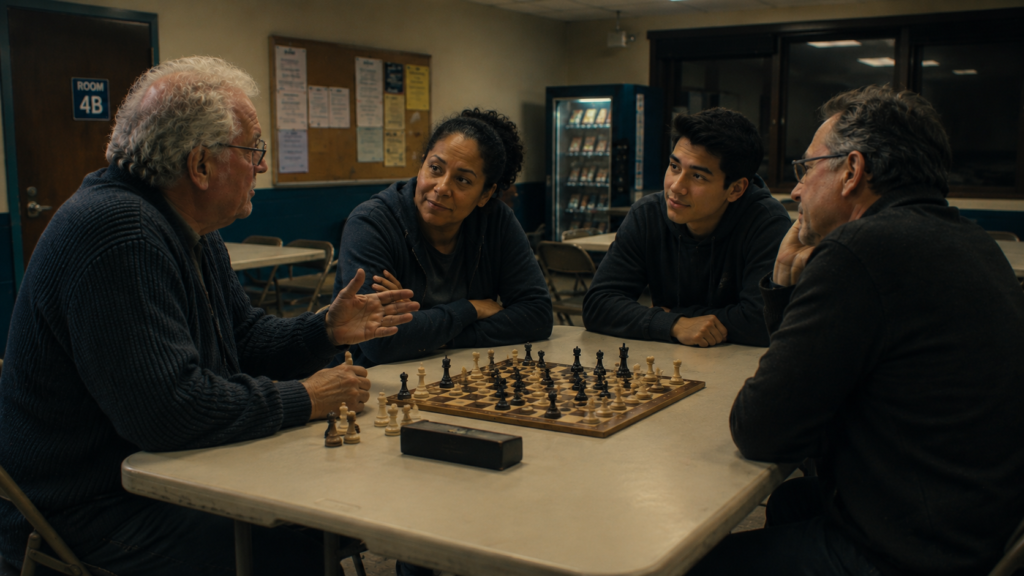
Nobody answered right away, and Warren regretted it almost instantly. It had sounded different outside his head — more personal than he’d meant. He tried again. “I live ten minutes from here. I’ve got a table. Coffee. We can bring a board.”
Keisha looked at Owen. Owen looked at Rafi. Rafi shrugged. “Every Thursday?”
Warren shrugged back. “Unless somebody finally teaches me to play properly.”
Owen stared at him. “We’ve been trying for three years.”
That set all four of them laughing, Warren included, and Lydia chose that moment to reappear in the doorway and ask whether they were planning to move in. They packed up the pieces.
The Following Thursday
At 6:40 the next Thursday, Warren set four mugs on the kitchen table. Then he took one away, because four looked presumptuous. Then he put it back. The board sat in the middle of the table. He tipped a bag of pretzels into a bowl, decided that made it look like a party, and poured them back into the bag.
At 6:51 he checked the window. At 6:54 he checked it again. By 6:56 he’d more or less concluded nobody was coming, and told himself that was fine. People agreed to things all the time simply because saying no on the spot was awkward. He should have known that. He should have thought of it before opening his mouth.
At 6:57, somebody knocked.
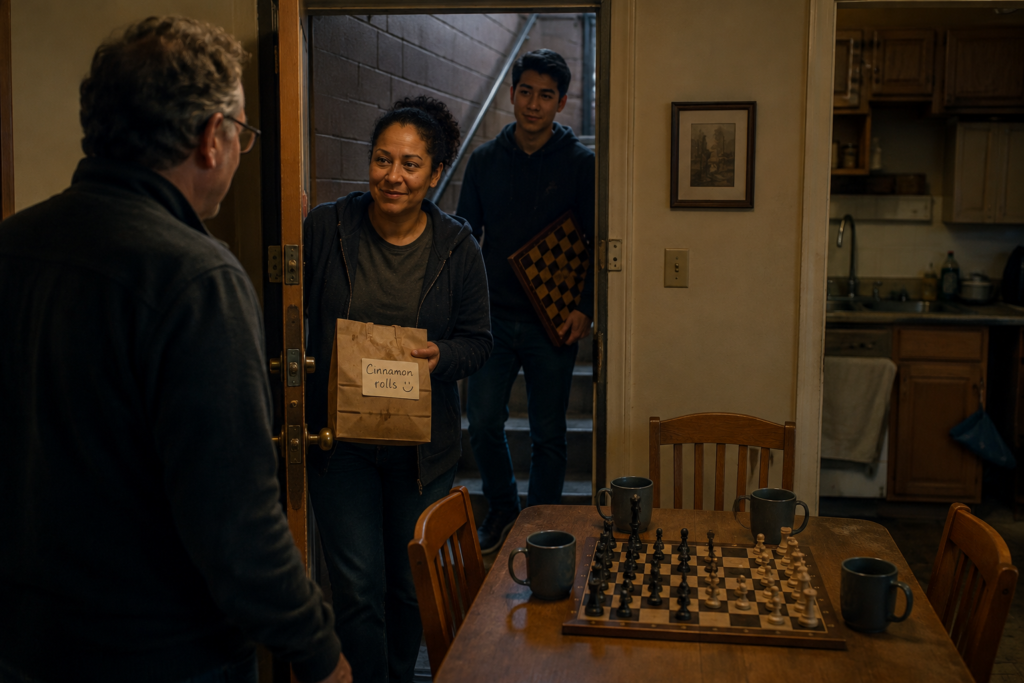
Keisha stood in the hallway holding a paper bag gone dark with butter at the bottom. “Cinnamon rolls.”
“I thought those were half-price after seven.”
“They are.”
“It isn’t seven.”
“I negotiated.”
Behind her, Rafi was coming up the stairs with the community center’s chessboard under one arm.
“You stole that?”
“Lydia said we could have it. Dance people don’t need a board.”
“That is exactly what a thief would say.”
Owen turned up six minutes late, took off his coat, complained the building had no elevator, and handed Warren a small cardboard box. Inside was a chess clock.
Warren looked at him.
“The old one was terrible,” Owen said.
“You bought this?”
“It was on sale.”
“Why?”
“Because the old one was terrible, Warren. Keep up.”
They sat down. Keisha opened the rolls. Rafi set out the pieces. Owen peered at Warren’s glasses and announced the left arm was loose.
“They’re fine.”
“They’re not.”
“I can see through them.”
“That is an embarrassingly low bar.”
Seventeen Minutes
Warren lost the first game in seventeen minutes.
“Personal best,” Rafi said.
“For what?”
“Fastest loss since I’ve known you.”
The second took twenty-two. The third never finished at all, because Rafi knocked his coffee over reaching for a cinnamon roll, and all four of them shot up at once.
“Napkins.”
“Kitchen.”
“Where?”
“Drawer by the sink.”
“Which drawer?”
“The one with the napkins in it.”
“That is not useful information.”
Keisha snatched the board out of the flood. Owen rescued the clock. Warren flung a dish towel over the spreading puddle, and Rafi stood there holding the dripping cinnamon roll that had caused the entire disaster. By the time it was mopped up nobody could remember whose move it had been, so they started over.
At 9:14 Owen looked at his watch. “We used to finish at nine.”
“Then go home,” Keisha said.
Owen thought about it. “No.”
They played until nearly ten.
Thursdays
They came back the next week. Then again. There were never any rules about it. Some weeks Keisha got there first. Rafi missed one Thursday during exams. Owen took to bringing his own tea, on the grounds that Warren’s coffee tasted like something used to degrease an engine.
Warren went on losing. Not every game anymore — just most of them.
By the start of summer the board had earned a permanent spot on the shelf beside the kitchen table, and four mugs lived in the cupboard directly above the kettle, because there was no sense keeping them anywhere else.
One Thursday evening Warren ran into his upstairs neighbor in the hall while he was hauling an extra chair back from the storage room. The woman tipped her head toward his door.
“You have people over every Thursday, don’t you?”
“Apparently.”
“I always hear you all laughing.”
Warren shifted the chair under his arm. “Sorry if we’re loud.”
“Oh, I don’t mind. I was just wondering what you get up to in there.”
Warren thought about it. There was a board on the table. There would probably be cinnamon rolls, because Keisha had texted to say she’d stopped at the bakery. Owen would find something to complain about within five minutes of walking in. Rafi had promised, again, to finally show Warren why he kept wrecking good positions by bringing his queen out too early.
All of that was hard to fit into a hallway conversation.
“Chess,” Warren said.
His neighbor nodded. “That sounds nice.”
Warren looked down at the chair under his arm, then got his key into the lock and shouldered the door open, the chair going in ahead of him.
“Kettle’s not going to boil itself,” he said, more to the chair than to her, and went inside to put it on.
