A Table Too Wide for the Hall
June Bell’s table showed up on a Thursday because she’d measured the hallway wrong.
She’d been sure the alcove outside 2B was forty-eight inches. She’d written forty-eight on the back of an electricity bill, underlined it twice, and carried the number across town to a secondhand furniture warehouse.
The table she bought was forty-six inches. The alcove was forty-three.
She learned this at 4:20 in the afternoon, standing in the hallway with one end of the table against her hip and the delivery driver holding the other.
“You want us to take it back?” he asked.
“How much?”
“Forty-five.”
“For driving it twelve minutes?”
“For driving it twice.”
She looked at the table. Nothing special — oak veneer, four square legs, a shallow drawer that stuck halfway out. Twenty-eight dollars, plus the first delivery. She’d bought it because her apartment was too small for the desk she actually wanted, and because she was tired of doing invoices at the kitchen counter with her elbows between the toaster and the fruit bowl.
She looked at her door. Then the table. Then the driver.
“Put it against the wall.”
“Here?”
“Here.”
He did.
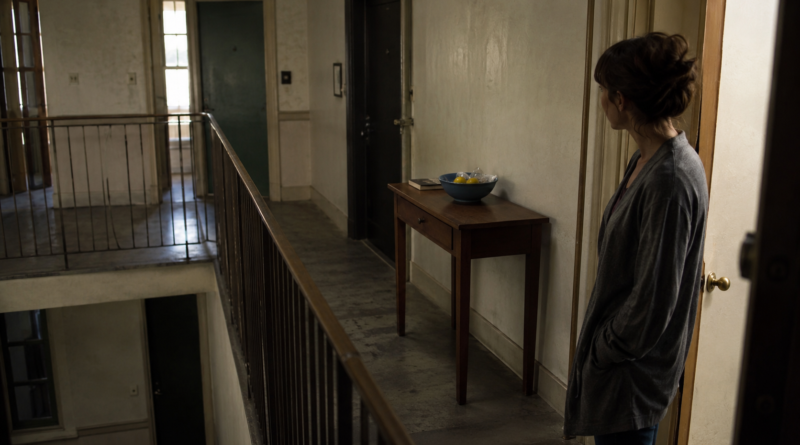
The table sat in the second-floor hallway, six inches too wide for the spot she’d meant it for and far too big to pretend it belonged there. She signed the slip.
For the next twenty minutes she stood inside her apartment with the door open, hoping an idea would show up. None did.
At 4:47, somebody put a lemon on the table.
The Lemon
She didn’t see who.
She’d gone down to check the mail. When she came back, there it was. One lemon. No bag, no note, just a slightly battered lemon near the middle of her twenty-eight-dollar mistake.
She picked it up. Put it back down.
At six she opened her door again. Now there were three lemons.
Across the hall, Mr. Baines was unlocking 2D.
“Are those yours?”
He looked at the table. “No.”
“Do you know whose they are?”
“No.” He considered the lemons. “Good color.”
Then he went inside. She left them there.
By Friday morning the lemons were gone. In their place sat a paperback detective novel with a bent cover.
Saturday
The building had twenty-four apartments and no real common room. There was a lobby downstairs, technically, but it held four mailboxes too many for the wall, a radiator, and a fake plant whose leaves had been collecting the same gray dust since June moved in.
People knew one another the way apartment people do. She knew 3A had a baby because she heard it. She knew somebody on four cooked with a lot of garlic. She knew Mr. Baines in 2D took his trash out every evening at exactly 7:10. She knew the twins downstairs had scooters because they left wheel marks on the lobby tile.
Names were harder.
Saturday morning she opened her door and found the paperback gone. A blue ceramic bowl sat on the table. Inside were six wrapped tea bags. Beside it, on the back of an envelope, somebody had left a note.
Take one.
She read it. Then went back in, found a black marker, came out, and added underneath: You can leave things too. Just not rubbish. She hesitated. Then added: Please.
At noon there were four tea bags. At three, two. At five the bowl held a packet of unopened birthday candles, a small screwdriver, and a coupon for a bakery on Calder Street.
She took the screwdriver. She’d needed one for months.
Rules
Monday, the building manager called. Owen Lyle. She’d spoken to him exactly twice — once about a leaking tap, once about a bicycle chained to the fire exit.
“Is that your table on two?”
“Yes.”
“It can’t block the corridor.”
“It doesn’t.”
“It might.”
“It either does or it doesn’t.”
A pause.
“Can a wheelchair get past?”
She looked through her open door at the space. “Yes.”
“Can two people get past each other?”
“Yes.”
“Can somebody get a sofa down?”
“Probably not.”
“You couldn’t get a sofa down before.”
“Then I’m not sure what we’re discussing.”
Another pause. “What’s the bowl?”
“I don’t know anymore.”
Owen came by that afternoon with a tape measure. The table left more clearance than the old radiator on the first-floor landing. He measured twice anyway. Then he looked at the bowl, which now held two batteries, a sealed packet of picture hooks, three mandarins, and a handwritten recipe for lentil soup.
“What is this?”
“Apparently the building has started exchanging objects.”
“Why?”
“I bought the wrong table.”
He looked at her. She pointed at the tape in his hand. “I’m aware that doesn’t answer your question.”
Owen picked up the recipe. “Good soup?”
“No idea.”
He put it back. “Nothing perishable overnight. Nothing electrical unless it works. Nothing sharp.”
“That seems reasonable.”
“And no clothes.”
“Why no clothes?”
“Because then it becomes a pile.”
She had no argument against that.
She wrote the rules on a piece of cardboard and propped it against the wall. By Tuesday somebody had added, in block capitals, NO JIGSAW PUZZLES WITH MISSING PIECES. Underneath, in different handwriting: HOW WOULD YOU KNOW? Under that: YOU KNOW.
She left all three.
The Drawer
The shallow drawer turned out more useful than the tabletop. Someone found it Wednesday. She knew because she heard it stick, then scrape open, then close.
When she checked later, three envelopes sat inside — not sealed, just old ones being used as labels. One said BUTTONS. One said TAKEAWAY MENUS. One said KEYS — UNKNOWN.
The key envelope held one small brass key.
She stared at it. This, she thought, was how systems became impossible.
Out came another piece of cardboard: PLEASE DO NOT LEAVE KEYS UNLESS YOU KNOW WHAT THEY OPEN.
Next morning, underneath: IT OPENS THE BLUE SUITCASE IN 4C. SORRY.
The key was gone.
Things That Moved
The strange part was how fast things disappeared. A roll of wallpaper left at eight was gone by nine. Three clean glass jars lasted eleven minutes. A nearly full box of colored pencils went before she finished making coffee. A plant cutting in a yogurt pot stayed two days, then vanished.
Someone left a calculator. Someone took it. Someone left a chess set with one white pawn replaced by a bottle cap. Someone took that too.
The items were never worth anything. That seemed to matter. Nothing on the table was worth stealing. It was only worth needing.
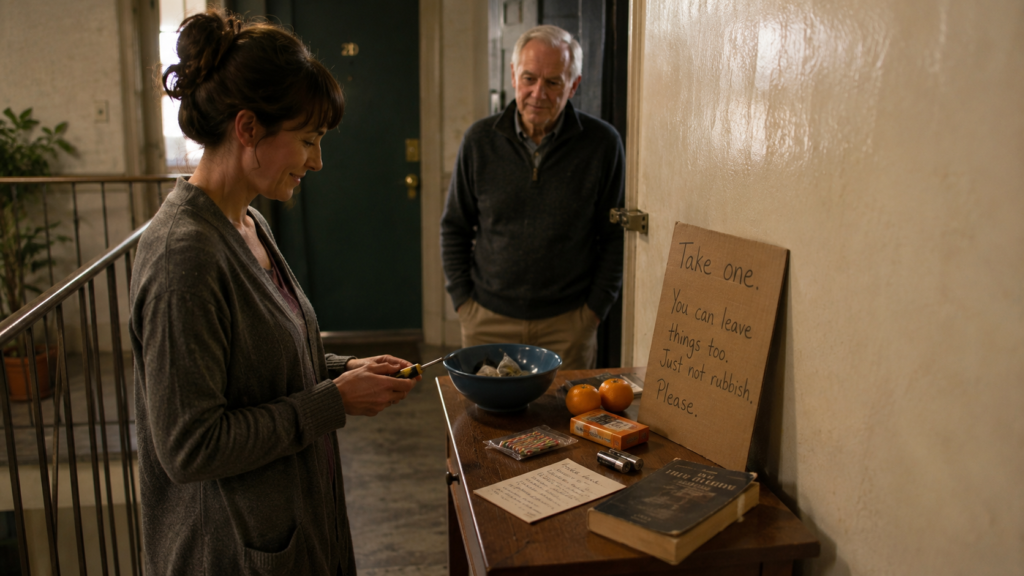
She started noticing people she’d known only as doors. The woman in 3C was Sarai, and she took the glass jars because she made jam. The man on the first floor with the red bicycle was Nestor, and he’d left the wallpaper because he’d bought too much for his daughter’s room. Mr. Baines was behind the mandarins.
“You keep putting fruit out there?”
“Doctor says I buy fruit.”
“That isn’t the same as eating it.”
“I buy it. I bring it home. After that, the medical system has had its chance.”
The twins downstairs contributed heavily and almost never usefully. A plastic dinosaur. One green shoelace. A deck of cards held together with an elastic band. A smooth stone with GOOD ROCK written on it in marker.
The rock was taken within an hour. That delighted them so much they spent the rest of the week hunting for another good one.
Thursday Again
A week after the table arrived, she came home carrying groceries and found a lamp on it. Small desk lamp, green metal shade, old-fashioned switch. A note taped to the base: Works. Bulb new.
She stopped. She’d been meaning to buy a desk lamp — not for this table, for the table she’d meant this one to be.
She set down the groceries and switched it on. Warm light spread across the wall.
“Take it.”
Sarai was coming up the stairs with an empty laundry basket.
“I don’t know whose it is.”
“Mine.”
“You’re getting rid of it?”
“I got another one.”
June looked at the lamp. “I took the screwdriver.”
“So?”
“And tea.”
“June.”
“And one of Mr. Baines’s mandarins.”
“That’s probably why he puts them there.”
June looked at her. Sarai shifted the basket to her other hip. “You know you’re allowed to use your own table.”
“I don’t think it’s my table anymore.”
“No,” Sarai said. “Probably not.”
June took the lamp inside.
The Invoice
That night she sat at her kitchen counter doing invoices, the green lamp beside her laptop. Better than the ceiling light. Less harsh. It made the small corner feel intentional.
At 8:15, a knock. Owen.
“Problem?”
“No.” He held out a sheet of paper.
She took it. A printed notice for the building. SECOND-FLOOR EXCHANGE TABLE, and below it the rules, typed properly. No food left overnight. No medication. No sharp objects. Electrical items must be functional. Small household goods only. Keep corridor clear. At the bottom: If the table becomes cluttered, items may be removed.
She looked up. “You made it official?”
“I made it less likely somebody complains to me.”
“That’s not the same thing.”
“It’s the closest you’re getting.”
He’d laminated it. She smiled despite herself. “Where am I supposed to put this?”
Owen looked at the wall. “I brought removable strips.” From his coat pocket he produced a packet.
She looked at the packet, then at him. “You could put those on the table.”
“I could.”
He put them on the table.
Neither moved for a second. Then June took one strip from the packet. “I’m taking one.”
“I assumed somebody would.”
What Stayed
The table never became anything grander than what it was. Nobody organized a committee. There was no newsletter. Nobody started calling the place a community.
Three weeks later somebody left a bread maker and Owen removed it because it was enormous. The twins tried to exchange a half-eaten bag of marshmallows and were overruled. Mr. Baines left four tins of tomato soup and took a wool hat. Sarai’s jam turned up twice in little jars with handwritten labels and disappeared both times before lunch.
The GOOD ROCK came back one afternoon with a second note added under the first: VERY GOOD ROCK. WOULD BORROW AGAIN. The twins carried it downstairs like they’d won something.
June kept doing invoices under the green lamp. She stopped thinking about buying a proper desk. The kitchen counter was fine.
One Thursday morning, exactly four weeks after the driver had left the table in the hallway, she opened her door on the way to work. The tabletop was empty except for the blue bowl. Inside was one lemon.
She stood looking at it.
Mr. Baines opened his door across the hall. June pointed. “Was the first lemon yours?”
He looked at the bowl. Then at her. “No.”
“You’re sure?”
“Yes.”
“Do you know whose it was?”
“No.”
June picked up the lemon. Mr. Baines locked his door.
“Good color,” he said.
She put the lemon in her bag and went downstairs with him.
