Founder Loses Her Mind at Table Five
This whole thing started because Margaret Whitfield couldn’t give a toast without waving her arms around.
Up at the front of the ballroom with a champagne flute in one hand, she was telling four hundred people how the charity had started in her late husband’s garage with a folding table and a coffee can. It was a good story. She’d told it eleven years running, and every year, at the part where she said and look at us now, she threw both arms wide like she wanted to get them around the whole room.
This year, at and look at us now, the clasp on her teardrop pendant gave out — the same clasp her jeweler had been after her to replace for two seasons. Off the back of her neck it slid, down inside the collar of her blue silk dress, off her hip, and onto the carpet behind the podium without a sound anybody could pick out over the clapping.
Margaret finished the toast. She raised her glass. Everyone clapped. She had no idea it was gone.
Four Minutes
Here’s what happened to the necklace over the next four minutes, none of which Margaret saw.
A waiter named Devon, clearing glasses near the podium, spotted something on the carpet. He picked it up, saw it was expensive, and did the right thing — flagged down the floor captain to hand it in. That floor captain, a brisk woman named Rosa, was running forty staff and twelve minutes behind. One look at the pendant and she made a reasonable wrong guess: that it belonged to one of her people, since a few of the senior catering staff wore small pins and bits of jewelry. Into the hands of the nearest server she pressed it. “This is yours, yeah? Pin it on before you lose it, we’ve got no lost-and-found tonight,” and she was gone before the server could answer.
That server was twenty-three, a woman named Priya working her fourth event for the company, who had never seen the pendant before in her life. But Rosa was already three tables off, and Priya had been told twice that night to do what the floor captain said and not argue, so she did the only thing that made sense. She pinned the very expensive, very much-not-hers diamond to her bowtie, figured there was a mix-up she’d sort out later, and went back to the water glasses at table five.
That’s how a teardrop diamond worth more than Priya’s car ended up sparkling on a catering waistcoat, in full view of the room, about six minutes before its owner came looking.
When Margaret Reached for Her Neck
She felt it gone before she understood it.
Down off the podium, taking a dozen warm hands on her arm, she reached up out of habit to touch the pendant — the way she’d touched it at every gala for fifteen years, the way you check for a thing that’s become part of you. Her fingers found her collarbone and nothing else.
She went cold. Then she went looking, with the controlled panic of a woman who won’t make a scene and is, on the inside, making an enormous one. She retraced her steps. She checked the floor by the podium. Down she got, in her blue silk, at her own gala, patting the carpet while a baffled board member asked if she’d lost an earring.
Then she stood up, turned around, and saw her dead husband’s anniversary gift hanging off the bowtie of a young woman pouring water at table five.
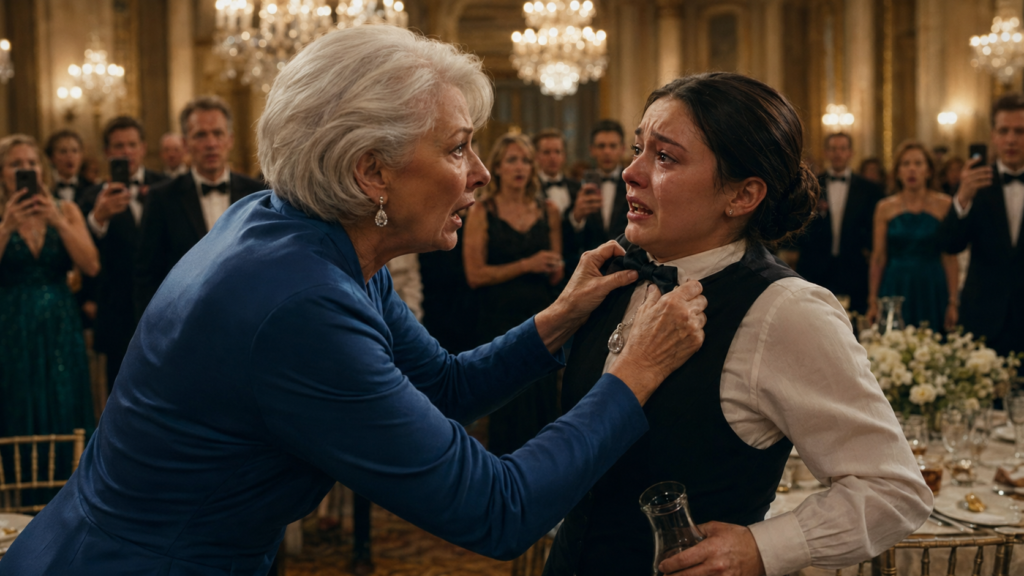
Table Five
Margaret did not handle this with her usual composure.
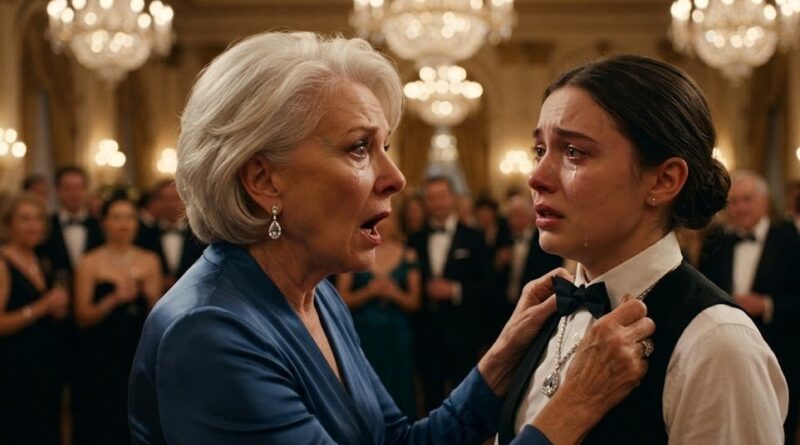
She crossed the floor faster than a woman her age in those shoes had any business moving, and before her brain could come up with one polite word, both hands shot out and caught Priya by the front of the bowtie.
“That’s mine!” It came out far louder than she meant, cracking with relief and shock and the leftover adrenaline of thinking it was gone for good. “That’s — where did you — that’s mine!”
Priya froze mid-pour with the pitcher in one hand. A woman in a blue gown had grabbed her by the collar in front of four hundred people and was accusing her of something. Her eyes went straight to filling. People around table five went quiet and turned, which made it worse, and several phones, regrettably, came out.
“I’m sorry — the captain gave it to me,” Priya got out, crying in earnest now, the helpless kind that comes when you’re accused in public and have no idea how to defend yourself. “She told me it was mine, she said pin it on, I’ve never seen it before tonight, I promise—”
Plain bewilderment on the girl’s face got through Margaret’s panic. This was not the face of someone who’d stolen a diamond. This was the face of someone handed a hot potato by management and now holding it in front of a firing squad. Margaret’s grip came loose.
Everybody Stop
What saved it was Rosa.
She’d been watching from across the room, saw her server get grabbed by the guest of honor, and came at table five at a flat run with the clipboard still in her hand.
“Okay — everyone, this is my fault,” she said, loud enough to cut the murmur, throwing both hands up in a way that happened to mirror Margaret’s toast. “I gave it to her. It got turned in, I assumed it was staff jewelry, I told her to put it on. She’s worked here four days. She did exactly what I told her. Mix-up’s a hundred percent mine.”
A beat passed while four hundred people reset the story they thought they’d been watching — not a society matron catching a thief, but three people all doing their best and getting it spectacularly wrong.
And then Margaret laughed.
It started as a huff and turned into the real thing, the kind that bends you a little at the waist. “Oh, good Lord,” she said, pressing a hand to her chest where the pendant should have been. “I just tackled a child over my own broken clasp. In front of the whole guest list. During my speech.” She turned to Priya, who was wiping her eyes and starting, carefully, to work out that she wasn’t in trouble. “My dear, I am so sorry. That was unforgivable. My husband bought me this thing and the clasp’s been hanging by a thread two years and I’ve nobody to blame but myself and possibly my jeweler.”
Priya gave a wet, startled laugh. “I thought I was getting arrested at a charity gala.”
“You very nearly were, by me, with no authority whatsoever.”
How It Ended
She unpinned the pendant from the bowtie herself, careful about it, and looked at the snapped clasp.
“Well. That’s that. I can’t even put it back on.” And then, because Margaret Whitfield had not run the most successful gala in the city eleven years by missing an opening, she straightened up and turned to the ring of guests still hovering with their phones.
“Since you all watched me assault the catering staff,” she said, “you can watch me make it right. Anybody who got that on video, it goes in the silent auction. ‘Founder Loses Her Mind at Table Five.’ We’ll auction the clip and the necklace together, broken clasp and all, and every cent goes to the garage fund.” She raised an imaginary glass at Priya. “And this young woman gets a very large tip and my apology in writing.”
Delighted, the room gave it a real warm round this time, the kind that comes when people find out they’ve watched something funny and human instead of something cruel. Devon, the waiter who’d found the thing in the first place, took a small bow he hadn’t earned and took the credit anyway. Rosa let out a breath for what felt like the first time in an hour.
That pendant did go in the auction. It sold, snapped clasp and all, for close to four times its appraised value to a tech investor at table nine who thought the whole story was the best thing he’d seen all season. Video sold separately. Between them, Margaret’s accident raised more in twenty minutes than the formal ask had raised all night.
Priya got her tip, the written apology on heavy cream paper, and a standing offer from Margaret to write her a reference for anything she ever applied to. She put the note in her bag. Toward the end of the night she found Rosa by the kitchen doors counting trays back in, and the two of them stood there a second, and Rosa said she was sorry about the whole thing, she really was, and Priya said it was fine, and asked whether they still needed her to break down table five or whether she could go ahead and start on the glasses.
