Built Crooked
“Stop the music.”
Daniel said it quietly, but the band heard him, and the string quartet trailed off mid-note. Two hundred guests turned toward the dance floor, where the bride and groom were supposed to be sharing their first dance. Instead, Daniel was standing very still, holding a phone that wasn’t his, and Claire was reaching for it with a hand that had started to shake.
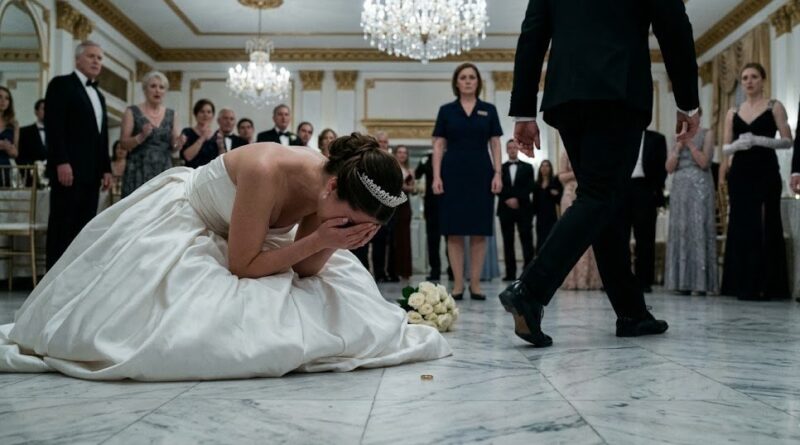
I should explain how we got here, because the photograph everyone keeps sharing — the bride folded over on the marble, the ring lying a few feet from her, the groom walking off with another woman steadying him by the hand — doesn’t tell you any of it. It just shows you the worst ninety seconds of two people’s lives and lets you fill in the rest. People always fill in the wrong rest.
Daniel and Claire had been together for six years. Everyone who knew them used the word “solid,” which is a boring word, but it was accurate. He was an architect, the kind who actually liked the unglamorous parts of the job, the load calculations and the drainage plans. She ran marketing for a regional hotel group, which was how they could afford the ballroom at all — she’d negotiated a rate that made the venue coordinator wince. That coordinator, by the way, is the woman in the navy dress you can see standing off to the side in the photo, the one with the expression that looks almost angry. Her name is Renata, and she is not angry. She is bracing. She’d watched a hundred weddings come apart in smaller ways, and she could read a room the second it tipped.
Phone That Wasn’t His
Here’s the thing nobody outside the family knew. Three weeks before the wedding, Daniel’s younger brother, Theo, had pulled him aside at the rehearsal dinner and tried to say something. Theo had a couple of drinks in him and a guilty look that Daniel mistook for nerves about the best-man toast. “There’s something I should’ve told you a long time ago,” Theo started, and then their mother called everyone to the table, and the moment closed up like water over a stone. Daniel told himself he’d ask later. He didn’t.
The phone on the dance floor belonged to Theo. He’d handed it to Daniel forty seconds earlier to take a photo of the newlyweds, a simple favor, and the screen had lit up while Daniel was holding it. A message. A name. A preview line of text that no brother should read about his bride three days into being married to her.
I won’t reproduce what it said. It doesn’t matter as much as you’d think. What matters is that it had a date on it. The date was eight months ago. And it made clear, beyond any soft interpretation, that whatever had happened between Claire and Theo had not been a single bad night that everyone could quietly bury. It had been going on. It had been going on while Claire was choosing flowers and Daniel was redrawing the seating chart to keep two feuding aunts apart.
Daniel looked up from the phone and found Theo across the room, and Theo’s face gave the rest of it away. He didn’t deny it. He just went pale and looked at the floor, which is a kind of confession.
What the Guests Saw
From where the guests sat, it must have been baffling at first. The groom standing motionless. The bride saying his name, then saying it again, louder. A few people near the back actually laughed, assuming it was some staged bit, a comedic interruption before the dance.
Then Claire reached for the phone and Daniel pulled it away from her, not roughly, just out of reach, and the laughter died.
“You read it,” she said. Not a question.
“How long,” he said.
She didn’t answer fast enough. That was the answer.
The woman you can see in the photograph holding Daniel’s hand as he walks away — the one in the pale champagne gown — is not a mistress, and I want to be clear about that, because the comment sections have decided she is. That’s Daniel’s cousin, Priya. She was seated at the front family table. When Daniel turned to leave the floor, his legs apparently went unreliable under him, the way they do when your body understands something a half-second before your mind catches up. Priya stood and took his hand to keep him upright. She walked him out because somebody had to. People want her to be a scandal. She’s just the person who got there first.
Ring
I keep coming back to the ring on the marble, because in the photo it looks deliberate, like a gesture, like he flung it down to make a point.
He didn’t.
Claire took it off. That detail got lost. In the thirty seconds between Daniel reading the message and walking away, she pulled her own ring off her finger, and she meant to hand it to him, or throw it at him, nobody’s sure which, including her. Her hand was trembling badly and it slipped, and it bounced once and rolled and stopped where you see it. Then her knees gave out and she went down onto the marble, and the bouquet she’d been clutching the whole time — those white roses Renata had spent the morning arranging — dropped beside her.
She wasn’t performing grief. I’ve spoken to people who were near her. They said the sound she made wasn’t loud. It was the small, awful sound of someone who has just watched the entire architecture of their life fall in on itself and who understands, with total clarity, that she’s the one who set the charges.
That’s the photograph. Bride on the floor with her face in her hands. Groom walking out. Ring between them on cold stone. Two hundred people not knowing where to look.
After Everyone Left
Renata did what venue coordinators do. She got the band packed up, she quietly told the catering staff to box the dinner that hadn’t been served, and she found Daniel’s mother and put a glass of water in her hand. She moved through the wreckage like someone who’d been trained for exactly this and hoped never to use the training. Around eleven that night, with the ballroom empty and the chandeliers still blazing over nobody, she was the one who picked the ring up off the floor. She kept it in the venue safe for two weeks, not sure who to give it back to, until Daniel’s mother finally came to collect it.
Theo and Daniel don’t speak now. I’m told Theo tried, in the way people try when an apology is more for themselves than the person they wronged, and Daniel told him there was nothing to discuss and meant it. The brothers had been close their whole lives. That’s gone, and it isn’t coming back, and the strange cruelty of it is that the affair cost Daniel two people, not one.
Claire moved to another city. She left the hotel group, which surprised everyone, since the job had been her whole identity. A mutual friend ran into her months later and said she looked tired but clearer, like someone who’d stopped pretending. She didn’t make excuses. She said the only true thing there was to say, which is that she’d done it, and she’d known it was wrong every single day, and she’d let it all roll forward anyway because saying it out loud felt impossible until a phone screen said it for her.
Daniel went back to work faster than anyone expected. He told a colleague that buildings made sense to him in a way people had stopped doing, and that he found that comforting rather than sad. He’s all right now, mostly. He kept the deposit on a house he and Claire had been planning to buy, and a year later he bought it alone, and he says he doesn’t regret that. A house should stand on its own foundation, he told the colleague, and you don’t tear the whole thing down because you found out it was built crooked. You just stop calling it the home you imagined and let it be the one you actually have.
That’s the part nobody photographs. The marble gets cleaned. The ring goes back in a drawer. And the people in the picture walk off in their separate directions and slowly become whole again, not because the break didn’t matter, but because it did, and they survived it anyway.
