We Had the Wrong Verb
The Word on the Wall
A man stood at the counter of the print shop where I do restoration work three afternoons a week, holding a photograph of his late father posed against a brick wall, and on that wall somebody had spray-painted a word I won’t repeat. He wanted it gone. Bricks painted back in clean, like the wall had always been blank.
I could have. That’s the part people don’t get about digital work — the software will happily manufacture a brick wall out of nothing, tile a pattern across the gap, and hand you back a lie so seamless you’d never catch it. I told him I could take the word out but that I’d be inventing the bricks underneath it, and asked whether that mattered to him. He thought about it and said no. His dad had just hated that wall. So I did it, and he left happy, and it was a fair job honestly done.
I bring it up because it’s the exact opposite of the job that came a few weeks after, the one I still turn over. That one was about refusing to invent anything at all.
The Woman Who Brought Glass
Most people bring me photographs in envelopes. Anjali Sundaram brought hers stuck to a pane of glass.
She set a shallow cardboard box on my worktable and lifted the lid. Inside was a broken rectangle pried out of an old frame, three corners whole and the fourth splintered inward, a jagged white fracture running clean through the middle of the image. What was left was almost unreadable. Two figures in long coats stood at the center. One looked to be a man in a brimmed hat. The other held something pale against her chest. Behind them a gray smear that could’ve been a building or a wall or just more damage.
The print had been underwater a long time. The gelatin emulsion — the light-sensitive layer that actually holds the picture — had swollen and pressed itself flat against the inside of the glass and dried there. Rust-brown tide lines ran across the bottom half. A few small patches had already peeled up and curled into brittle little scrolls.
“They’re my grandparents,” she said. “That’s what my mother wrote on the frame, anyway.”
She turned the backing board over. In blue ink, faded but readable, someone had written: Esther and Nikhil, autumn 1974.
“Do you know where it was taken?”
“No idea. We always figured they were out for a walk somewhere.”
I looked again at the two blurred shapes. “What would you like me to restore?”
“Whatever’s actually left. I don’t need it made perfect.”
That’s the right answer, and almost nobody gives it. Most people want perfect. They want the damage scrubbed off until it looks like it never happened, and they don’t understand that what they’re asking for is fiction.
What the Water Had Changed
Photographic paper from the seventies came in layers. A paper base, a coating, and on top the gelatin emulsion carrying the silver compounds that form the image. Water doesn’t just stain those layers. It rearranges how they hold together.
When gelatin takes on moisture it expands, and pressed against something smooth like glass it turns adhesive. As it dries it shrinks again, and sometimes it grips the glass harder than before. So you can’t just peel the photograph off. Pull it away by force and the paper backing comes free while the image stays behind on the glass as a transparent skin. You don’t separate the photo from the glass. You separate the photo from itself.
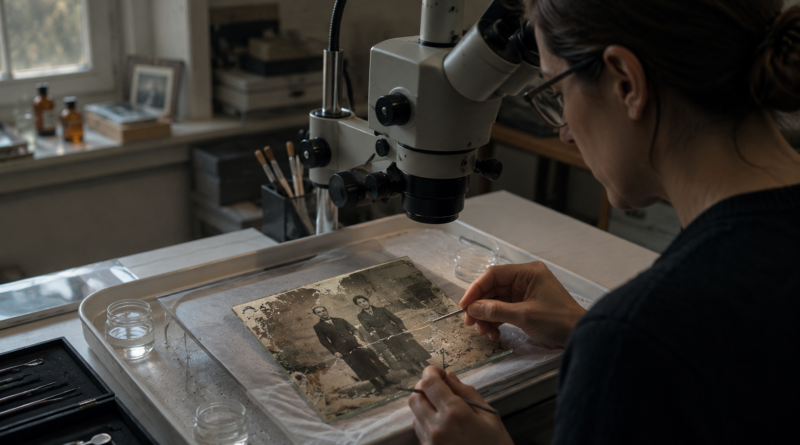
I put the fragment under the stereomicroscope and looked at it slowly. The dark areas had bonded hardest. Along the man’s coat the emulsion clung in scattered islands. Near the woman’s shoulder a cluster of tiny bubbles marked where water had gotten in and dried unevenly. Mold along the top edge too, old and inactive, fine branching lines like pale roots crossing the border.
Before I touched any of it, I photographed the whole object from every angle. Front, back, raking light from each side, ultraviolet, close views of every crack. This part isn’t optional. Restoration can’t be undone even when you do it right, so the only record of what a thing looked like before you started is the one you make yourself. Once you change the object, its former self lives only in those files.
Then stabilization. I lifted the loose glass splinters away with fine forceps and laid small bridges of Japanese tissue across the weakest breaks. Then I built a humidity chamber — a sealed conservation tray with a raised perforated platform and blotters dampened with deionized water underneath.
The photograph never touched the water. It sat above it while the trapped humidity rose, slowly, over the better part of an hour. This is the part that separates the job from the disaster. Raise the moisture just enough and the gelatin softens into something flexible. A hair too far and it dissolves and takes the image with it. That single degree of difference is more or less the entire craft.
One Millimeter at a Time
I started at the least damaged corner.
Using a microspatula with a rounded tip, I tested the seam between paper and glass. Where the resistance was low I advanced a fraction of a millimeter at a time. Where the emulsion still held, I stopped and left it. I brushed in a little deionized water mixed with a photographic wetting agent, which drops the surface tension so the moisture creeps into the narrow channels without flooding the print and drowning it.
The first centimeter took nearly an hour.
Several times the paper backing lifted while the emulsion stayed behind as that transparent skin, and each time I laid the print back down, nudged the humidity up, and waited. I could’ve gone faster. Faster would only have gotten me to a cleaner-looking failure sooner.
By the end of the afternoon half the image had come free. And underneath the glass, things showed up that hadn’t been visible from above. The woman’s gloved hand. The man’s trouser cuff. The corner of a wooden crate. The pale object held against her chest, which Anjali had assumed was a purse, turned out to be a folded blanket.
Next morning I released the last section near the fracture. A patch of sky had stayed behind on the glass, so I faced that fragment with a temporary gelatin support, lifted the retained emulsion, and aligned it back onto the print under the microscope. The join wasn’t invisible. It wasn’t meant to be. The job is to preserve information, not to pretend the damage never happened.
Once it was fully separated, I washed the print in controlled baths to draw out the soluble contaminants, then dried it face-up on a polyester support under a screen that kept it from curling without pressing it artificially flat.
And for the first time I could see the whole scene. Two people standing ankle-deep in moving water.
When the Background Started Talking
The digital stage started with a high-resolution scan — not on a flatbed, which would’ve pressed the fragile emulsion back against glass all over again. I used a medium-format camera mounted above a copy table, cross-polarized lights to cut the glare off the uneven surface, separate exposures for the highlights, the shadows, and the surface texture, merged into one calibrated composite.
People misunderstand digital restoration. They think it means invention. And it can invent — it can fabricate windows and faces and whole streets that were never there. I don’t let it. My corrections stay locked to confirmed information only. Removing color casts, balancing density, rebuilding a scratch from the pixels right beside it, combining details that exist in different exposures. Where an area holds no recoverable evidence, I leave it unresolved. A blank is more honest than a guess.
As the contrast came back in the background, a tall shape rose above the man’s shoulder. I took it for a lamppost. Then I made out a round face and two dark hands. A clock tower.
Off to the left, half hidden behind the woman’s hat, a street sign. Four letters came through clearly.
MILL
Below it, a row of sandbags.
I enlarged the picture to four hundred percent. Behind the couple, seven or eight people stood in a line running from a storefront out toward the flooded street, and every one of them was holding something. A parcel, a bucket, a blanket, a wooden box.
Esther and Nikhil Sundaram hadn’t been out for a walk. They were standing in a chain.
Four-Seventeen
I phoned Anjali and asked her to come back in. Before she arrived I went into the municipal archives — not chasing a story, verifying one. The clock tower belonged to the old North Market building, torn down in 1988. Mill Street had run along its east side. The flood hit on October 12, 1974, after almost eleven inches of rain fell across the county in under two days. The newspaper photos from that week showed sandbag walls along Mill Street and volunteers carrying medical supplies out of a threatened pharmacy and up into the second floor of the market hall.
One archived shot had been taken from across the street. The same clock, in that photograph, read 4:17.
Anjali stood next to my monitor while I opened the final file. I walked her through it in stages — the original glass-bound print, the physical separation, the infrared and ultraviolet records, the calibrated scan, the finished restoration. I wanted her to see that nothing had been conjured, that every recovered detail had a source.
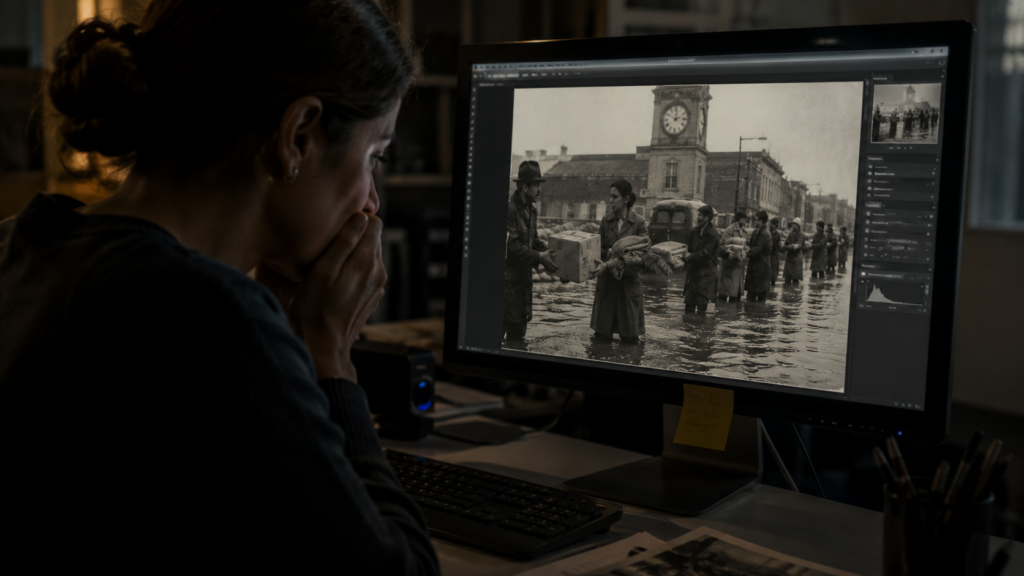
The photograph was still damaged. A pale scar ran across the lower corner. Part of the man’s hat stayed indistinct. The water had wiped several background faces out for good. But Nikhil Sundaram was unmistakably handing a wooden box to the next volunteer in the line. Esther held a stack of folded blankets wrapped in oilcloth. Behind them the sandbags curved toward the pharmacy door.
I set the newspaper photograph on the table beside the screen. Anjali leaned in close.
“My grandfather fixed watches,” she said. “He set every clock in the house two minutes fast. Every single one.” She pointed at the tower. “Four-seventeen.”
Neither of us said anything for a while.
There was no reason to inflate it into a legend. The photograph didn’t prove her grandparents had led the rescue or saved anyone in particular. It showed something quieter and more exact. They had been there. They had stood in cold moving water on Mill Street and passed supplies from one pair of hands to the next while the river came through the town.
I printed the restored image on cotton-rag paper and sealed the original in a custom archival enclosure, kept apart from the broken glass. The glass went into its own labeled sleeve, because it belonged to the object’s history too, and throwing it out would’ve been its own kind of falsification.
Before she left, Anjali looked at the print one more time. “We had the wrong verb,” she said.
“How do you mean?”
“We always said they were walking.” She looked down the line of volunteers. “They were working.”
After she’d gone I logged the project in the studio database. Gelatin silver print, severe water damage, partial emulsion transfer, local infill, digital reconstruction based only on surviving image data. Under historical identification I typed one line: Mill Street flood relief, October 12, 1974. Clock tower reads 4:17 p.m. Then I saved the file, shut the lamp off, and went to see if the front counter needed covering.
