You Still Owe Me for That Shoe
The Graveyard Shift
Here’s something they don’t cover in broadcasting school: the good stuff never happens when anyone’s awake to hear it.
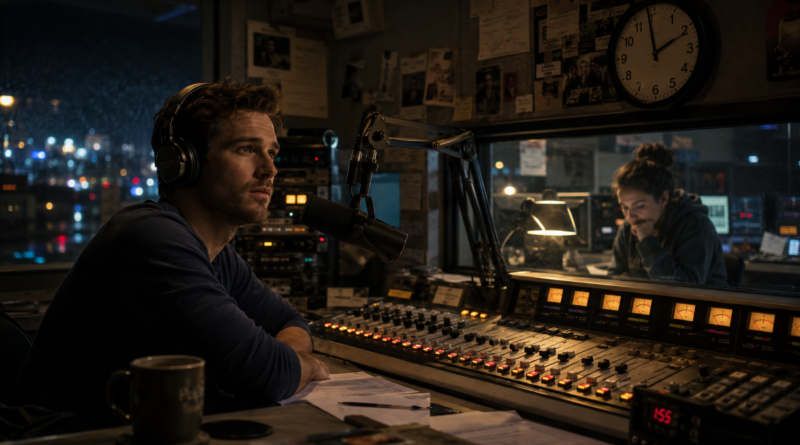
Milo Vant had gotten used to that. He’d wanted mornings — afternoons at least, some slot where the city was moving and a little decent talk might build him something. What he’d drawn was midnight to four on 98.7, the shift they hand the newest guy because nobody with options wants it. Two years in and it was still his. Some nights he suspected it always would be.
The thing about overnights is they teach you to listen. When you’ve got a few hundred people scattered across the dark at any given hour, each one lands differently. He knew his regulars. A woman who ran a delivery route and called to stay awake on the long flat stretches. A retired schoolteacher who wanted to fight about grammar and only that. The insomniacs, the recently dumped, the plain lonely. He’d learned to treat every call like it mattered, because at that hour, to that person, it usually did.
A Goat, He Said
It was 1:15 on a wet Tuesday when the board lit up with the one that changed things, though he had no way of knowing that yet. He punched the line and put it through.
Older man. Warm, a little gravel in it, already laughing at whatever he was about to say. He gave his name as Walter and asked if Milo remembered the old Ironwood Bridge. Milo didn’t, and said so. Torn down decades back, Walter told him, ripped out for the highway that runs through there now. But in its day it had been all black steel and rivets, thrown across the river like a set of ribs.
Then he told the story.
Summer of ’74. There had been a goat. Milo assumed he’d misheard. He hadn’t. A goat, loose from somewhere, had gotten itself up onto the beams in the middle of the night and would not come down. Walter and his best friend spent the better part of an hour trying to talk it off the bridge. Their masterstroke, Walter said, with real pride, had been a cherry pie, fresh out of the oven, used as bait to walk the animal back to solid ground.
Milo was grinning by the end. It was the kind of thing that made a bad shift worth showing up for, a scrap of local history nobody else would’ve bothered to keep. He thanked Walter, told him he’d made the night better, and sent him off with a song.
He figured that was the peak of the night. He figured wrong.
The Correction
Twenty minutes on, the board lit again. Still in a good mood, Milo put it through expecting more of the same, some other old-timer wanting to reminisce.
What came out of the speakers was dry, tickled, and faintly aggrieved.
“That last fella of yours. Walter.” A pause. “Terrible memory on that man.”
Milo sat up.
“First off,” the caller went on, “it was not a cherry pie. It was a blueberry muffin, it was half-eaten, and I know that for a fact.” Another pause, weighted with about fifty years of grievance. “Because it was my muffin. And that goat ate my left shoe.”
Milo laughed out loud, which is a genuine sin when you’re supposed to be the only voice on the air. Couldn’t help it. The man gave his name as Roy, and as he kept going Milo felt his arms go up in gooseflesh.
Roy and Walter had been best friends. Not the loose kind you collect in your twenties — the kind that feel more like a brother, the two of them stuck together through every stupid thing a young man can find to do. A goat on a bridge included.
Then Roy’s voice shifted. The fun drained out and something older came in behind it.
They’d fallen out. Thirty-five years back. Over something so dumb Roy could barely make himself say it — a borrowed pickup, a mix-up about who’d said what and when, a few sharp words neither man would take back. And because they were, in Roy’s own words, the two most bullheaded fools in the county, neither one ever picked up the phone. Thirty-five years. Not a word.
Milo sat frozen with the whole thing playing out in his headphones and understood, with a small electric jolt, that he had maybe ten seconds to decide what to do with it.
Line Two
He didn’t think it over. Couldn’t afford to.
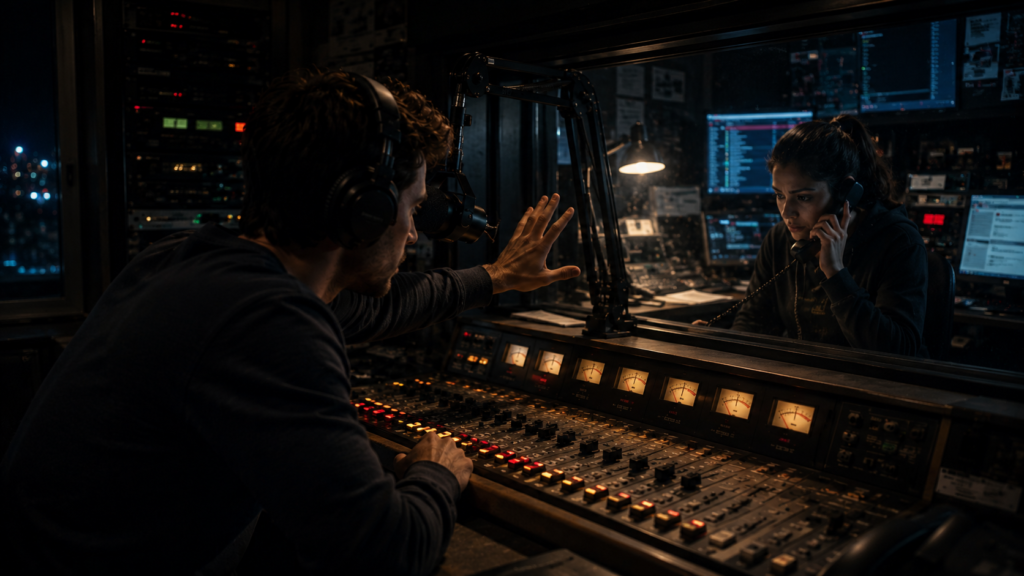
He muted the mic and spun toward the glass, waving both arms at his producer like a man flagging a plane down off a runway. Priya was half-asleep over her coffee and snapped upright at the sight of him. He scrawled a note and slapped it to the window.
FIND WALTER. CALL HIM BACK. LINE TWO. NOW.
She read it twice. Then her eyes went wide as it landed, and she lunged for her phone. The caller-ID log still had Walter’s number from twenty minutes prior, and Milo watched through the glass while she dialed, waited, talked fast and low, and held up two fingers.
Line two, lit.
He took a breath. Kept Roy talking, kept him wandering happily through the truck and the muffin and the goat. And then, no warning to either man, no setup at all, he reached over and merged the calls.
For a second, nothing. Just the open-line hum, two receivers connected across a city gone quiet and dark. Out there a few thousand insomniacs and night drivers sat in their kitchens and their cabs holding their breath without knowing why.
Then Walter, not yet getting it, said, “Hello?”
The silence after that was the longest of Milo’s career.
Thirty-Five Years
He could hear both of them breathing. He caught the exact instant Walter understood who was on the other end — a sharp little pull of air. Neither said anything. The seconds stretched, and Milo made himself sit on his hands and not fill them, because some silences you leave where they are.
Finally Roy cleared his throat. And in a voice working very hard to sound gruff and not quite pulling it off, he said:
“You still owe me for that shoe, Walt.”
A beat. Then Walter laughed — not a chuckle this time, a big helpless rolling thing that came up from somewhere deep and took his whole body with it, and under it Milo could hear he was crying too, both at once, and after a moment Roy’s gruffness split straight down the seam and he was doing the same. Two old men and three and a half decades of stubbornness coming apart all at once over the air at half past one in the morning.
Milo pulled his headphones half off and let it happen, and noticed his own eyes had gone unreliable.
The Rest of It
No going back to the playlist after that. The remainder of the night belonged to the two of them.
They talked the better part of an hour and Milo mostly stayed clear, chiming in only to keep it moving. They filled in the missing years. Walter had married, had grandkids now, one just starting college. Roy had lost his wife a few years back and admitted, quiet, that he’d thought about calling when it happened — picked the phone up more than once and set it back down every time. They squabbled about the goat, the muffin, whose fault the truck really was, and it got obvious to everyone listening that neither cared anymore who’d had the right of it. They’d each just wanted the other one back and hadn’t known how to say so.
And the city listened. The board lit and stayed lit, other people calling in not to talk about themselves but to say they were sitting in some parking lot crying, or that they’d just texted a brother they hadn’t spoken to in years. Priya kept feeding the messages through the glass and he read a few on the air, and every one set the two of them off laughing again.
Before they signed off, Walter and Roy made plans for breakfast that same morning. Roy said he knew a diner. Walter said he’d better, and that Roy was buying, on account of the shoe. They were still going at it about the shoe when Milo finally, gently, let them go.
He put on a song after that — something quiet — and sat alone in the dark studio while it played.
The clip went everywhere the next day. The station phone didn’t stop, and inside a week he had the afternoon slot he’d always said he wanted. He took it, in the end. But he hung onto the overnight a while longer too, because he’d worked something out that night he didn’t want to lose track of. He’d always figured the job was filling the empty hours with the right song. Turned out that wasn’t it. Some nights the job was just leaving the line open and staying out of the way. Priya knocked on the glass and pointed at the clock — 1:55, dead air coming — and he pulled the headphones back on and reached for the next track.
