What Fits in an Overhead Bin
I was standing in a hotel room in a city that wasn’t home, running on three hours of sleep I’d stolen in fragments across eleven time zones, and I wanted two things. A shower and the clean shirt I’d folded on top of everything so it would be the first thing I saw. The suitcase was mine. Gray hardshell, the model that maybe forty percent of the traveling world seems to own, combination lock still sitting at the factory default of triple zero because I’d never once bothered to change it. I thumbed the latches and lifted the lid.
Inside was someone else’s entire life.
Not My Shirts
There’s a specific lurch your brain does when it looks at a thing it knows and a thing it doesn’t know in the same space. For a second I thought I’d been robbed and refilled — that some elaborate prank had swapped my contents and left the shell. Then it resolved into the obvious. Not my suitcase. It only looked exactly like my suitcase.
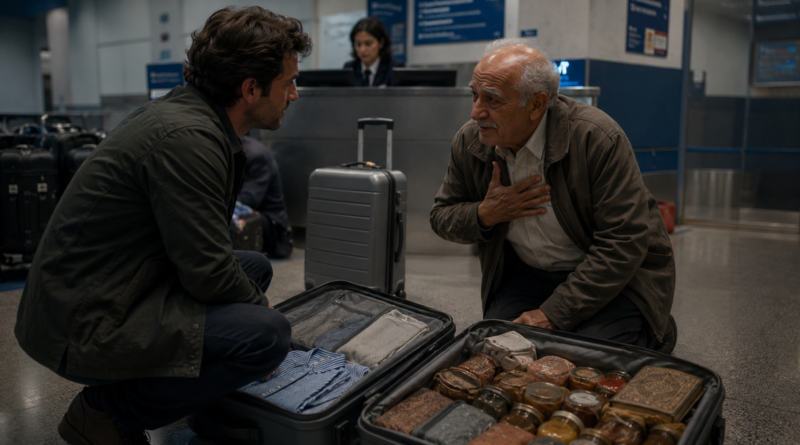
Where my shirts should have been were glass jars, a dozen of them, packed into careful nests of cloth. Deep red powders, ochre-yellow ones, something the color of dried moss, each jar labeled by hand in a flowing script I couldn’t read. Under the jars, textiles, folded with the kind of precision that comes from doing a thing ten thousand times — woven fabric in patterns I’d never seen, the threads gone soft and a little faded along the creases where they’d been folded and unfolded across what had to be years. At the very bottom, wrapped in more cloth, a small stack of books. Old ones. Spines cracked white, pages swollen soft at the corners, the title on the cover printed in an alphabet that was beautiful and shut to me completely.
I sat down on the edge of the bed and looked at it. Somewhere out there, I understood, a stranger had pulled a gray suitcase off the same carousel, thumbed the same lazy triple-zero lock, and was about to open it onto my rumpled business casual and a toiletry bag with a shampoo bottle that leaked. I almost felt sorry for them. Almost. Mostly I felt sorry for myself, because I knew what came next, and what came next was the airport.
Calling the Void
If you have never spent forty minutes of your one short life on hold with an airport baggage department, I envy you, and I hope you never do.
The number was on the back of my claim ticket — the little stub they staple to your boarding pass, the one you’re supposed to keep and most people ball up and lose on the way to the taxi rank. I’d kept mine. That turned out to be the single competent decision I made all day. I dialed. A cheerful recording thanked me for calling and told me my call was important, then laid out nine menu options, none of which was “I have someone else’s suitcase and it’s full of spices.” I pressed the number closest to my actual problem and got a second menu, then a third, then a stretch of hold music that seemed built in a lab to wear the will down.
While I waited, I did the thing everyone does now, which is look it up on my phone. I’ll save you the trouble, because somewhere in the fog of that music I did actually learn how you’re supposed to handle this. If you ever open the wrong bag, or lose your own, here’s what genuinely helps. Keep the claim tag — that stapled stub has a barcode tying you to your specific bag in the airline’s system, and without it you’re just describing a gray suitcase to a person who has heard “gray suitcase” nine thousand times, but with it you’re a tracking number. Photograph your bag before you fly, one shot of the outside and one of the packed inside, because when you’re trying to prove which anonymous rectangle is yours, a photo ends the argument on the spot. Put an ID tag on the outside and a second one resting inside on top of your clothes, since outside tags get torn off in transit constantly and the inside card survives everything. Tie something ridiculous to the handle — a bright ribbon, a strip of neon tape, a novelty keychain — because it costs nothing and means you never grab the wrong bag in the first place, which was the whole reason I was on the phone. And report the swap in person if you can, fast, because the sooner it’s logged the sooner the other traveler’s matching report links to yours. These things get solved in pairs.
A human came on right as I finished reading that last one. I explained. There was a pause, and then something I didn’t expect — a small, warm laugh. “Oh,” the woman said. “We’ve been waiting for you. Somebody’s been here since this morning.”
The Man Who Waited All Day
I took a cab back that evening, the wrong suitcase riding in the trunk like a hostage I was returning.
The baggage office was a fluorescent room tucked behind the carousels, laminate counter, a wall of unclaimed bags, that smell of industrial carpet cleaner. Sitting in one of the plastic chairs against the wall, small and very upright, hands folded in his lap, my gray suitcase standing at his feet, was an old man.
Seventy-five, maybe. Pressed collared shirt buttoned all the way to the top, a jacket that was old but spotless — the outfit of a man who dresses carefully for anything that counts, and this counted. When he saw me come through the door wheeling the twin of the case at his feet, he stood up so fast he had to catch the back of the chair, and his whole face came apart with relief.
He said something to me in a language I didn’t know. I said something back in English he didn’t know. We stood there understanding that we understood nothing, and then he did the only thing that needed doing. He pointed at the suitcase in my hand, pressed his palm flat to his own chest, and his eyes filled.
The clerk helped where the words overlapped. His name I made him say twice so I’d get it right — Fadel. He’d flown in from very far to live near his son, who was working somewhere across the city and couldn’t get away to meet him. He’d been at the airport since morning, the clerk gathered, refusing to go home, refusing to let anyone drive him anywhere, because everything he owned that mattered was inside a gray suitcase that had walked out the door behind a stranger.
We knelt down together on that ugly carpet and opened both bags to confirm the swap, and that was when I understood what I’d been carrying around all day.
What We Drag Behind Us
The jars, he explained through the clerk and through his hands, were spices you couldn’t buy here. Not rare exactly, but specific — the exact ones from the exact market that made food taste like the place he was born. The textiles were his wife’s. She’d woven some of them herself, and she’d died two years ago, and these were what he had of her hands. The books were poetry. He tapped the cover of the top one and said a line of it under his breath, not to me, just to feel it in his mouth, and not understanding a syllable of it I could still hear it was something he’d known by heart for fifty years.
He had left a whole country. A language, streets he’d walked as a young man, a wife’s grave, friends he wasn’t going to see again. And he’d taken the unpackable size of all that and gotten it down to what would fit inside one rolling plastic box small enough to lift into an overhead bin. That’s the part I keep coming back to. This is what these identical gray suitcases actually hold, all of them, on every carousel everywhere. Not clothes, not really. We tell ourselves we’ve packed our shirts and our chargers and our travel shampoo, but what we’re dragging behind us through those cold bright terminals is some compressed core of who we are, trusted to a handle and a lock most of us never bother to set.
He kept trying to give me things. Got a jar half out of the bag and pushed it at me, insisting, and I kept gently pressing it back, and the clerk laughed and said he wouldn’t stop until I took something, so in the end I let him hand me one of the smaller jars of deep red spice, because refusing had become the ruder option. He closed my hand around it with both of his — dry and warm and stronger than I expected — and looked at me and said the one word in English he’d clearly practiced. “Thank you.” Carefully. “Thank you.”
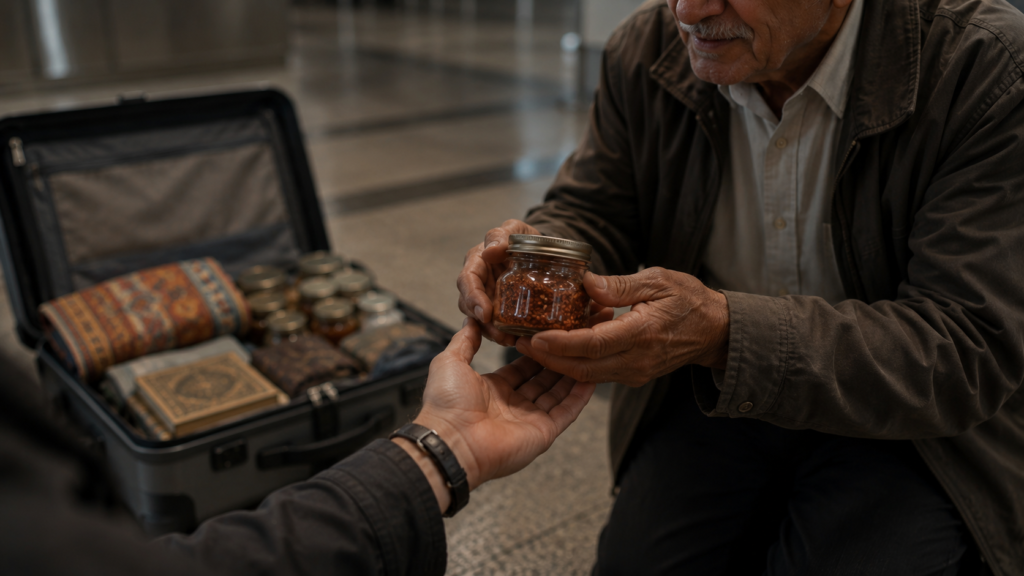
His son turned up twenty minutes later, breathless, apologizing to the whole room, and the two of them loaded the right suitcase into a car and drove off into a city that was going to become, slowly, some version of home. I wheeled my own boring bag back to my own boring hotel. My shirts were still folded on top right where I’d left them, faintly smelling of someone else’s shampoo now, and that struck me as the least important detail of the entire day.
I still have the jar. It sits in the kitchen and I’ve never used a grain of it, because using it isn’t the point. Every so often I catch it up on the shelf and think about the old man sitting bolt upright in a plastic chair for nine hours, guarding an empty patch of floor where his whole world was supposed to be. And how close it came to being gone for good, all of it, because two strangers owned the same gray suitcase and neither of us had ever changed the lock. I changed mine that week. Smallest possible way I could think of to promise I’d be more careful with what I carry.
