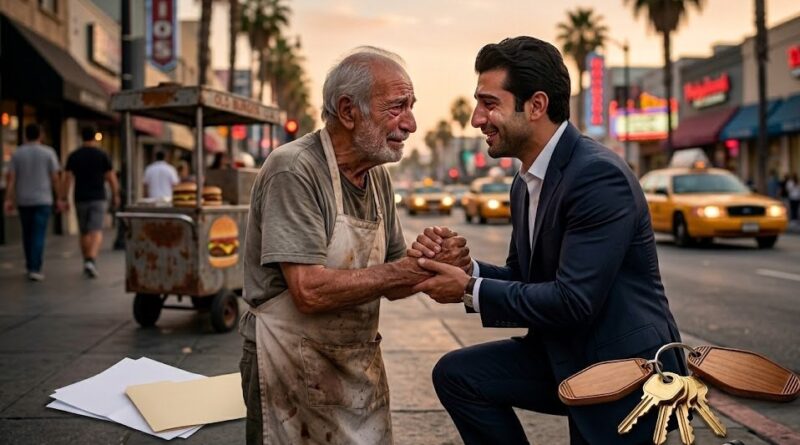
Grumpy Vendor Waves Away the Cash
The young man in the suit was crying, and Auggie Pirkanen could not for the life of him figure out why, because all he’d done was return a set of lost keys.
This was the part that nobody walking past on the boulevard understood, and it was the part that the moment looked like but wasn’t. To anyone glancing over — and plenty were, the way people do on a busy street at dusk — it read like something enormous. An old food-cart vendor in a battered apron, gripping the hands of a well-dressed younger man who was visibly overcome, a set of keys on a carved wooden fob lying on the pavement between them along with some scattered papers. It looked like a reunion. It looked like the end of a long story.
It was, in fact, about eleven minutes old, and it had started with a dog.
What Actually Happened, in Order
Auggie had run his cart on this corner for nine years. Not thirty-one. Nine. He was not a beloved neighborhood institution, he had no decades of quiet generosity behind him, and he would have been the first to tell you that he was, on most days, kind of a grump. He sold a decent dog and a better sausage and he did not give them away for free, because he had a lease on an apartment and a daughter in community college and margins that did not allow for sentiment. He was sixty-three, his knees were shot, and he was counting the years until he could stop standing on concrete for ten hours a day.
About twenty minutes before the photograph, a golden retriever had come bolting down the sidewalk dragging a leash, no owner in sight, the way dogs do when a leash slips. It had skidded to a stop at Auggie’s cart, drawn by the smell, and Auggie — who was a grump but not a monster — had grabbed the leash before the animal could shoot into traffic. The dog had a collar. The collar had a little capsule on it. Inside the capsule, instead of a phone number, was a tightly rolled slip of paper and, threaded onto the same ring, a small set of keys on a carved wooden tag.
This is an unusual thing to find on a dog. It would become the whole point.
The young man came sprinting up the boulevard maybe ninety seconds later, suit jacket flapping, calling a name — “Biscuit! BISCUIT!” — with the specific panic of a person who has lost something irreplaceable. He’d reached the cart, seen Auggie holding his dog’s leash, and nearly collapsed with relief. And then he’d seen what Auggie was holding in his other hand: the keys, which Auggie had unclipped from the collar to look at, trying to find a number to call.
That was the moment the young man broke down. Not because of the dog, exactly. Because of the keys.
Who the Young Man Was
His name was Devraj Anand, he was thirty-one, and he had been having the worst month of his life.
His father had died seven weeks earlier. Suddenly, a heart thing, no warning. His father had been a private man, a widower, who’d lived alone in a small house across the city and kept his affairs to himself in the way of his generation. And after the funeral, Devraj had run into a problem that sounds small and is not: he couldn’t find anything. His father had a safe deposit box at a bank — Devraj knew it existed, there were statements — but he could not find the key, and without it the whole process of settling his father’s estate was jammed. The bank needed the key or a long, expensive, drawn-out legal drilling process. Devraj had torn the house apart twice. Nothing.
What Devraj didn’t know, because his father hadn’t told anyone, was where his father had hidden the key. His father had been an anxious man about security, the kind who didn’t trust drawers or hiding spots in the house because houses get burgled. So he’d done something his anxious mind found clever: he’d put the safe deposit key, along with a slip of paper noting the box number, into the little capsule on the collar of the dog he walked twice a day. The dog was never burgled. The dog was always with him. The key was, in his father’s logic, the safest it could possibly be.
Then his father died, and the dog — Biscuit — went to Devraj along with everything else, and Devraj, grieving and overwhelmed, had no idea that the very thing he’d spent seven weeks frantically searching for was hanging the entire time around the neck of the golden retriever sleeping at the foot of his bed.
He’d never thought to check the collar. Why would you check a dog’s collar for the key to a bank vault?
The Slip of Paper
Devraj found out the way you find out the most important things in life, which is by accident, in the middle of a crisis, on a public sidewalk.
When Biscuit slipped the leash and bolted and Devraj chased him eight blocks in a full suit and finally caught up to find a hot dog vendor holding his dog — and holding, inexplicably, a set of small keys he’d just unclipped from the collar — Devraj’s brain made the connection his grief had blocked for seven weeks. He grabbed the keys. He saw the bank’s logo embossed faintly on the little plastic tag threaded alongside the carved wooden one. He unrolled the slip of paper from the capsule with shaking hands and saw, in his late father’s careful handwriting, a box number and four words: Dev — this is everything.
That was when he started to cry, kneeling on the pavement, and grabbed the bewildered vendor’s hands, because he had just been handed, by a complete stranger, by sheer dumb luck, by a dog who got loose and ran toward the smell of grilling onions, the one thing that had been blocking him from laying his father to rest. The papers scattered on the ground were the estate documents he’d been carrying around for weeks, the ones that needed that exact key to move forward. He’d been on his way to a lawyer’s office to start the drilling process, dog in tow because he couldn’t bear to leave Biscuit home alone in his current state, when the leash slipped.
Auggie’s Confusion
From Auggie’s side, none of this made sense in real time.
He was holding a leash and a set of keys, trying to do a small decent thing — find the owner of a loose dog, maybe see whose keys these were — and suddenly a grown man in an expensive suit was on his knees gripping his hands and weeping and saying “thank you, thank you, you have no idea, you have no idea what you just did.”
“Pal,” Auggie said, baffled, “I just grabbed your dog before he ran into a cab. The keys were on his collar, I was trying to find a number—”
“That’s it. That’s exactly it.” Devraj laughed through the tears, wiping his face with the back of his hand, leaving a smear. “You don’t get it. These keys. I’ve been looking for these keys for seven weeks. My father died. This is the key to his safe deposit box and I couldn’t find it anywhere and it was on the dog the entire time and I never thought to look and if Biscuit hadn’t run to your cart I’d have spent the next six months and ten thousand dollars drilling that box open—” He had to stop. “You just handed me my dad. That’s what’s in that box. Everything he left. You just handed it to me because you caught a dog.”
And Auggie, slowly, got it. Not the details, but the shape of it. He’d done something that cost him nothing, that took ten seconds, that he’d have done for anybody — and it had landed, by pure accident, on the exact center of a stranger’s grief and unblocked the whole thing.
He didn’t know what to say. So he did the thing grumpy men do when they’re moved and don’t have words for it. He gripped the kid’s hands back, firmly, and said, “Okay. Okay, son. It’s okay. You found ’em. They’re right here. Nobody’s drilling anything.”
The Debt
Here is where the title earns itself, and it’s not the way it looks.
Once Devraj had collected himself, and clipped Biscuit’s leash properly, and gathered his scattered papers off the pavement, he tried to give Auggie money. A lot of it. He pulled out his wallet right there, overwhelmed and grateful and not thinking clearly, and tried to press a thick fold of cash into the vendor’s hand. “Please. Take it. I owe you. You don’t understand what this is worth to me—”
Auggie pushed it back. Firmly. This is the part that surprised even Auggie, because he was not a man who turned down money, and he genuinely needed it.
“No,” he said. “No, put that away. I’m not taking money for catching a dog. That’s not a thing I’m gonna do.” He looked at the kid — at the smeared face, the suit, the grief still raw under the relief. “You want to pay me back? Fine. Here’s the debt.” He pointed at the golden retriever, now sitting placidly between them, tongue out, the cause of all of it, utterly unaware. “That dog clearly meant the world to your dad. Walked him twice a day, hid his whole life on his collar ’cause the dog was the one thing he trusted. You take care of that animal like your old man did. That’s the debt. That’s all of it. Paid in full the day you got here.”
It landed harder than the money would have. Devraj looked at Biscuit, and understood that the dog wasn’t just a dog he’d inherited along with the furniture — the dog was the thing his father had loved enough to make the keeper of his secrets, the daily companion of a lonely widower’s last years. And Devraj, in his grief, had been treating Biscuit as one more overwhelming responsibility instead of as the last living piece of his father.
“Okay,” he said quietly, crouching to put a hand on the dog’s head. “Okay. Deal.”
Why “Gold”
The “gold” of the title was three things at once, and Auggie only understood one of them.
It was the dusk light, gold all down the boulevard, on the palms and the cabs and the two of them. It was the golden retriever, the literal gold of the dog whose loose leash had set the whole accident in motion. And it was the thing Devraj kept trying to name and couldn’t — that the most valuable transaction of his terrible month had been done by a stranger who refused payment, that the debt had been paid in something better than gold and then forgiven on the spot.
That was the photograph. Not a reunion of old friends. Two men who’d known each other for eleven minutes, one of them weeping with relief, the other gruffly insisting it was nothing, a dog between them and a set of keys on the ground that had just unlocked a dead man’s last gift.
After the Boulevard
Devraj opened the safe deposit box two days later. Inside was, indeed, everything — the documents that settled the estate, but also things his father had never mentioned: letters, old photographs from before Devraj was born, a watch that had been his grandfather’s, and a sealed envelope addressed to Devraj in the same careful hand as the slip on the collar. He read it alone. He never told anyone exactly what it said, except that it was the conversation he’d thought he’d lost the chance to have.
He went back to the boulevard the next week. Not to give Auggie money — he’d learned that lesson — but because he wanted the grumpy vendor to know how the story ended, since Auggie had been part of it without choosing to be. He brought Biscuit. Auggie, who pretended to be annoyed at the interruption to his lunch rush, fed the dog a sausage on the house, which Devraj noted was the only free item the man had ever knowingly given away in nine years, and which Auggie insisted didn’t count because dogs don’t pay anyway.
They became, improbably, something like friends — the unsentimental hot dog man and the young guy who walked his late father’s dog past the cart most evenings now, having moved to an apartment a few blocks over partly, Devraj admitted, because he liked that the corner was there. Biscuit got a sausage every time. Auggie maintained, to the end, that he hadn’t done anything that day. He’d just caught a dog.
But Devraj knew what he’d actually done. Sometimes the most important thing one person ever does for another isn’t a sacrifice or a long-held kindness finally repaid. Sometimes it’s just being the person standing on the right corner when a dog runs by — being willing to grab the leash, look at the keys, and try to do the small right thing — and then, when it turns out to matter more than you could have known, being decent enough to wave away the reward and tell a grieving stranger that the debt was already paid.

Is there more to the story?