Four Degrees Before Opening
Four Degrees
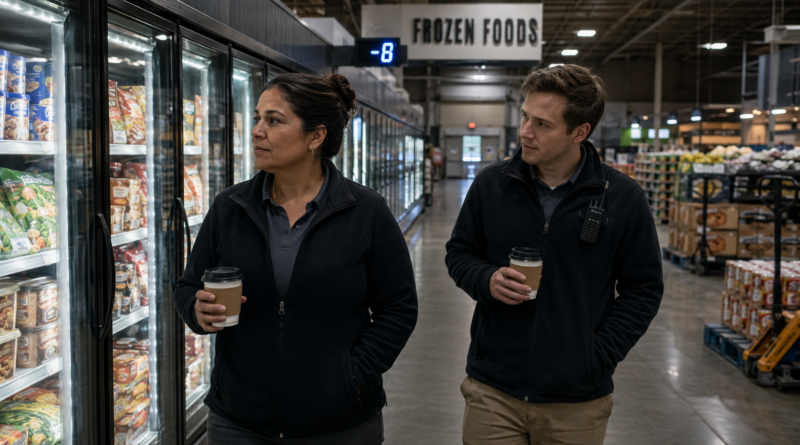
At 6:43 on Monday morning, the thermometer above the frozen-food aisle read 4°F.
Maribel Cross noticed because she’d been reading that thermometer at about the same time every weekday for nine years. She stopped with one hand on a pallet jack.
The store wasn’t open yet. Half the ceiling lights were still off and the place lay in alternating strips of glare and shadow. Behind produce, a floor scrubber whined through its last pass. Hot sugar smell drifted over from the bakery. At receiving, a delivery driver was arguing with somebody about six missing cases of bottled water.
She looked at the thermometer again. Four degrees. Those cases were supposed to hold comfortably below zero.
She put her palm flat against the glass door. Cold. Opened it and reached between two bags of peas. Colder. Nothing soft, no frost melting, the compressor running with its usual low hum.
“Great,” she said.
Equipment failed one of two ways, she’d learned. Loudly, which was expensive, or quietly, which was worse.
Before Seven
She found Ellis Rourke in the stockroom, cutting shrink wrap off a pallet of cereal. Twenty-six, assistant manager for eleven days, still carrying the store radio clipped exactly where the training photo showed it.
“Freezer aisle’s at four.”
He looked up. “Four what?”
“Degrees.”
“Is that bad?”
She stared at him.
“I heard it as soon as I said it.” He set down the box cutter.
They walked out together. The thermometer read five now.
Ellis pulled out his phone. “Do we call maintenance?”
“Yes.”
“Do we move everything?”
“Maybe.”
“How much is everything?”
She looked down the glass doors running nearly the length of the aisle. Pizza. Vegetables. Ice cream. Frozen dinners. Fish. Waffles. Bags of fruit. Three shelves of things involving cauliflower that nobody had asked cauliflower to become.
“A lot.”
Ellis called the refrigeration company. Maribel went for the handheld probe in the manager’s office.
The Problem With Air
The technician on the phone asked Ellis questions he couldn’t answer. Was the case temperature rising steadily? He didn’t know. Were all sections hit? He didn’t know. Any alarms on the controller? He didn’t know where the controller was.
Maribel took the phone.
The tech wanted product temperatures, he said, not the display over the aisle. That made sense. The wall number measured air, and air jumped every time a door opened. The food changed slower.
She checked a box near the front. Then one in the middle. Then one at the back. Still hard.
“Could be a sensor,” he said. “Could be airflow. Could be the start of something bigger. I can get somebody there between nine and noon.”
She looked at the clock. Fifty-one minutes to open. “That’s a very large between.”
“That’s the best window I’ve got.”
She hung up. Ellis waited beside her with a legal pad. “What do we do?”
She liked that he asked. The last assistant manager had usually started by explaining why whatever she’d noticed was probably fine.
“We stop filling the cases. Keep the doors shut. Check product temps every fifteen minutes.”
“And if they start rising?”
“Then we get busy.”
He wrote it down. “You want me to tell Darnell not to stock frozen?”
“Tell everybody.”
He lifted the radio. She stopped him. “And don’t say the freezer’s failing.”
“But it might be.”
“It might also be a twelve-dollar sensor. You tell fourteen employees the freezer’s failing, and by eight somebody’s cousin is posting that we’re selling melted chicken.”
He lowered the radio. “Right.” He tried again. “Hold frozen stock in the back freezer until further notice. Do not restock aisle seven.”
Better.
Eight Degrees
At 7:22 the display read eight. Products still fine. At 7:37, nine. At 7:52, seven. Then eight again.
Customers had started coming in. Maribel watched them open the doors. One man stood with a door hanging open, reading the ingredients on four nearly identical breakfast sandwiches. She wanted to tell him that whatever he was after wasn’t going to turn up in the fifth minute. She waited instead. He finally picked one.
The display climbed to ten.
Ellis showed up at the end of the aisle. “That guy held the door open forever.”
“I saw.”
“Could that be doing it?”
“Some of it.”
“So maybe nothing’s wrong.”
“Something’s wrong.”
“How do you know?”
“Because people held that door open yesterday too.”
That seemed to bother him more than the number did. Good, she thought. He was learning.
The Cart Problem
At 9:18 one section started warming faster than the rest. Not dangerous. Not yet. But enough.
Ice cream first. Ice cream was unforgiving — a bag of corn could take some inconvenience, but ice cream remembered everything.
Ellis brought two shopping carts. She looked at them. “No.”
“What?”
“We’re not pushing two carts of ice cream through an open store.”
“Why?”
She pointed toward the front. Customers. “Because then we spend the next hour explaining why we’re pushing two carts of ice cream through an open store.”
They used gray stock totes. Darnell Webb came from receiving with a flat cart, and the three of them moved cartons fast, holding each door open as little as they could.
A woman with a toddler watched. “Are you getting rid of the ice cream?”
“Just moving some stock, ma’am,” Ellis said.
“Why?”
He looked at Maribel. She kept loading. “Equipment check.”
“Oh.” The woman took this completely and moved on to waffles.
Ellis waited until she’d gone. “That worked.”
“Most true answers do.”
Eleven Twenty-Six
The technician arrived at 11:26. Cormac Vale, carrying a tool bag heavy enough to hold a smaller technician.
He listened to the case. Checked the controller. Opened a panel. Then walked twenty feet down the aisle, crouched, and looked under the bottom shelf.
“Found your problem.”
They both bent down. Nothing dramatic. No burned wire. No broken fan. No puddle. A strip of thin plastic packaging had been sucked against the return-air grille, clear except for a narrow green edge.
Cormac pulled it free.
“That’s it?” Ellis asked.
“That’s part of it.”
“Part?”
He pointed deeper into the grille. Dust — not ordinary shelf dust but a thick gray layer built up behind the reachable section, where nobody saw it on a routine cleaning. Air was moving, but badly.
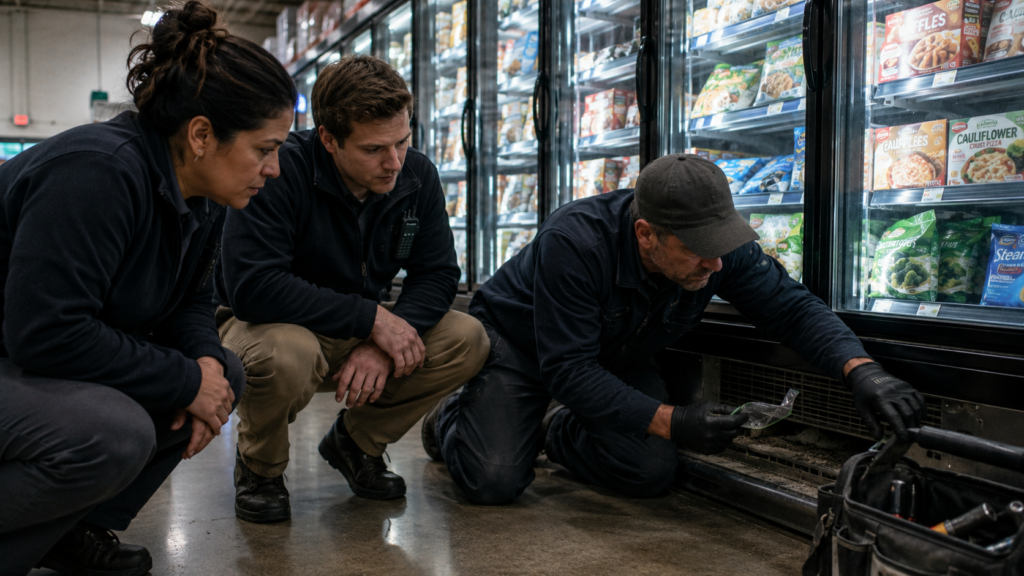
“Plastic probably pushed an already marginal system over the edge,” Cormac said. “You’ve got restricted airflow. Unit’s working harder than it should.”
“So the freezer isn’t broken.”
Cormac looked at him. “It is not working correctly.”
“That sounds like the same thing.”
“It’s a useful difference when somebody has to pay the invoice.”
Maribel liked him immediately.
The Checklist
By one o’clock the display had dropped below zero. Nothing lost. The ice cream stayed in back until the readings held; the rest never climbed high enough to dump. Cormac cleaned what he could, wrote up the problem, and recommended a full service before the next scheduled maintenance.
That should have been the end of it.
Ellis came looking for her at two. She was in receiving, checking a delivery of canned tomatoes. He had the legal pad again.
“I changed the opening checklist.”
She looked at him. The old one had twenty-three boxes. Front doors. Registers. Restrooms. Bakery case. Produce misting system. Walk-in temps. Freezer display. She’d checked that last box hundreds of times. That was how she’d found the problem.
He showed her the new version. Under Frozen Foods he’d added three lines:
- DISPLAY TEMPERATURE
- PRODUCT SPOT CHECK
- AIR RETURN CLEAR
She read it twice. “You can’t probe frozen product every morning.”
“Why not?”
“Because at six-thirty we’ve got two people doing six people’s work.”
He crossed it out. “Weekly?”
“Twice a week.”
He wrote that. “What about the grille?”
“Visual check daily. Proper cleaning gets its own schedule.”
He wrote that too. Then stood there, pen hovering. “What else?”
She looked at him. “You’re asking the wrong question.”
He waited.
“The checklist was already long enough. Keep adding a box every time something goes wrong, and in five years opening the store takes till lunch.”
“So what do you do?”
“You take things off too.”
That, apparently, had not occurred to him.
They went through the list. It still had a line telling staff to check whether a promotional DVD display was powered on. No DVD display in the building for four years. Another line had the opener unlock a side entrance that had been sealed during a remodel. One item said to inspect a coffee grinder pulled before Ellis had even started.
He crossed out all three.
She pointed to another. “Don’t need that.”
“Why?”
“Produce does it on their own sheet.”
Crossed out.
They got it from twenty-three down to nineteen, new freezer checks included. Ellis looked more pleased with that than he had when the temperature dropped.
Tuesday
Next morning she got in at 6:38. Hung her coat in the break room, clipped on her radio, walked the sales floor before touching the pallet waiting in receiving.
The freezer display read minus six.
She crouched by the first case. The return grille was clear. She stayed there a moment, looking through the glass at rows of frozen vegetables stacked under the white case lights.
“Lose something?”
Ellis, behind her, holding two coffees.
“No.”
“You’re on the floor.”
“I’m aware.”
He handed her one. She took it. They stood there drinking coffee in front of the freezer with the store still closed.
After a minute Ellis said, “I went through the closing checklist too.”
She turned her head slowly. “How bad?”
“Thirty-one items.”
“How many are real?”
“Twenty-four.”
“That’s still too many.”
“I knew you were going to say that.”
They started toward the stockroom. Behind them the freezer kept running at minus six, which was exactly what it was supposed to do.
