Three Hundred and Twelve Dollars
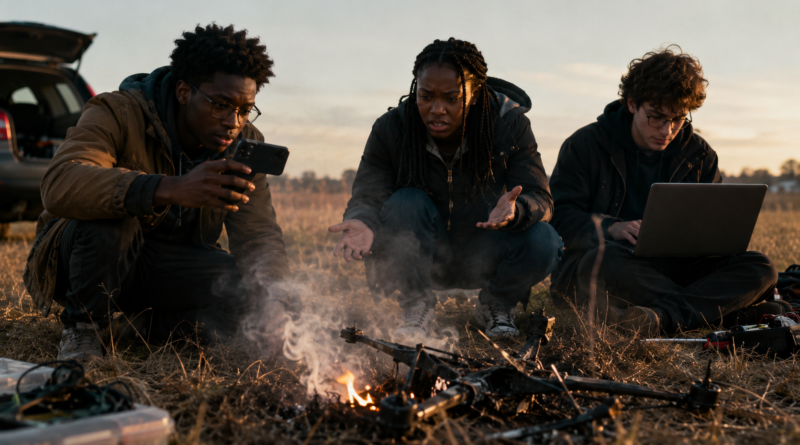
The drone was on fire, and Wole was filming it with his phone instead of putting it out.
“Do something!” Ngozi shrieked, hopping in place.
“I am doing something. I’m documenting. This is content.” He tilted the phone for a better angle while the quadcopter sat smoking in the grass, one propeller arm blackened and drooping. “Nobody’s going to believe the motor caught fire on the bench test. We haven’t even left the ground. We’re supposed to go to space and we can’t clear the parking lot.”
Ngozi stamped out the little grass fire with her sneaker, swearing, and the third member of their doomed enterprise — Osei, who hadn’t looked up from his laptop through any of it — said mildly, “That’s the third ESC. We keep pulling too much current. The batteries can’t handle the cold-weather draw we’re spec’ing.” He typed something. “We need a bigger power budget or a smaller dream.”
“We’re not shrinking the dream,” Wole said, pocketing the phone. “The dream is the whole point.”
The dream, if you could call it that, had started three weeks earlier in a diner at one in the morning, over the worst milkshake any of them had ever paid for. Ngozi said it tasted like cold chalk. Wole said, flat, that they should just freeze a proper one at forty thousand feet where it was cold enough to do it right, and Osei — who treated every joke as a specification — pulled a napkin over and started sketching.
Now they had a whiteboard covered in math and a budget of three hundred and twelve dollars, which was every cent three broke second-years could scrape together.
The Stupid Beautiful Machine
The goal was pointless in a way that felt almost holy. Build a rig that could freeze a small milkshake at high altitude on nothing but the ambient cold, loft it on a weather balloon, recover it, and find out whether stratospheric freezing beat a kitchen freezer. It wouldn’t. They knew it wouldn’t. Not the point. The point was the problem — a real one, gnarly, spread across four disciplines, that no professor had assigned and no grade hung on.
And the obstacle wasn’t the freezing. It was the opposite of that. A milkshake that froze too fast became a brick of dairy concrete, unpourable and useless. What they needed was controlled freezing, slow enough to keep the texture, inside an environment that wanted to flash-freeze everything at once at sixty below.
Osei went after it with a stubbornness that bordered on the spiritual. He built an insulated chamber out of salvaged aerogel scraps and a repurposed lunchbox, tuned so the shake would cool over twenty minutes instead of twenty seconds. Ngozi rigged a tiny motorized paddle from the guts of a dead electric toothbrush, to keep the mixture churning as it chilled the way an ice cream maker does, so the ice crystals stayed small. And Wole, who was better with his hands than his attention span suggested, machined a mount that would hold the whole absurd thing steady through a balloon burst and a forty-mile-an-hour fall.
It cost them four dead motors, one grass fire, and an amount of arguing that would be hard to overstate.
Launch Day
They drove ninety minutes out of town on a cold clear Saturday, to a flat scrubby field where the FAA wouldn’t care and nobody would ask. The wind was dead — the rare still morning a balloon launch needs.
Filling the balloon took twenty white-knuckled minutes. Ngozi held the neck while it swelled to the size of a small car, the pull upward building until her arms shook. Osei ran the last check on the microcontroller: churn paddle responding, chamber sealed, GPS chirping its position, cameras rolling. Wole poured the milkshake in at the last possible second — a plain vanilla, because they’d sunk the budget into aerogel and couldn’t afford anything better — and sealed the lid.
At 9:02 they let go.
The payload jumped skyward, climbing a thousand feet a minute, shrinking against a hard blue sky. Ten minutes and it was a speck. Twenty and it was gone, and the three of them stood in an empty field grinning like idiots at a patch of sky where their milkshake used to be.
The Chase
Tracking a balloon is mostly refreshing a map and praying. Their software called a burst somewhere around ninety-four thousand feet and a drift of about thirty-five miles east.
They crammed into Wole’s dying hatchback and drove.
At sixty thousand feet the telemetry cut out, exactly as expected — air too thin, cell network losing its hold. That was the part that gnawed. The entire freezing sequence would happen up there, in the silent dark stretch, on its own. If the paddle seized, if the chamber cracked, if the shake flash-froze into a brick in spite of everything, they wouldn’t know until the box was in their hands.
The car got quiet. Ngozi chewed her thumbnail. Osei stared at the frozen map. Wole, for once, didn’t narrate.
Almost two hours later the laptop pinged. Ngozi lunged for it. “Signal — it’s coming down, eleven thousand feet, dropping fast.”
The Payload
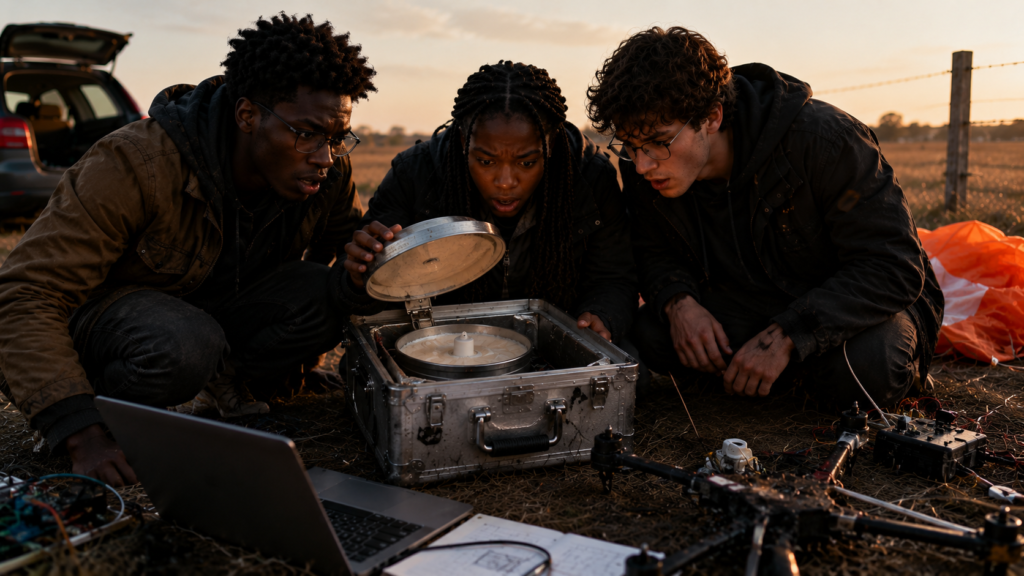
They found the orange parachute snagged in a fence line at the edge of a cattle field, the whole rig swinging gently in the breeze, dented but whole.
Wole unlatched the lid and the three of them leaned in over it, shoulder to shoulder, holding their breath. The cameras were still blinking — they’d caught the whole flight, the earth curving off below, the black of near-space, the balloon bursting in that eerie silence. But the real thing was the churned chamber at the center of the rig.
Ngozi worked the inner lid off with cold-numbed fingers.
Inside was a milkshake. Not a brick. Not a slush. A genuinely good milkshake — thick, soft-frozen, the paddle having done its slow patient work, fine-crystalled and smooth, with a thin delicate glaze of ice on top from the last cold of the descent. The controlled freeze had held. Against every reasonable expectation, the stupid beautiful machine had done exactly what it was built to do.
“It’s real,” Osei said, which from him was basically weeping. He poked it with the paddle. It gave, softly, the way a milkshake should.
What They Actually Built
They split it three ways with a spoon out of Wole’s glovebox, standing in the dirt by a cattle fence forty miles from anywhere.
By any honest measure it was a fine milkshake. A little vanilla. A little melted at the edges from the drive down. Not meaningfully better than one from any diner, which was the thing they’d all quietly known and launched anyway.
But that wasn’t what they’d made, and they all understood it as the spoon went around.
They’d taken a dumb joke from a one-a.m. diner booth and turned it into a controlled-freezing problem, a power-budget problem, a churn-mechanism problem, a recovery problem — a dozen real engineering problems stacked on a completely unserious question. And they’d solved every one. The milkshake was the excuse. The solving was the thing.
Ngozi licked the spoon and passed it to Wole. “We should do espresso next. Kwame in our lab keeps saying the library coffee tastes like boiled pennies.”
“Absolutely not,” Osei said. “Do you have any idea what extraction does at ninety thousand feet? The pressure alone—” He stopped. He was already reaching for a napkin. He was already sketching.
Wole pulled out his phone and started filming him do it, because this, too, was content.
The rig sits now in a glass case in the corner of the engineering lounge — dented chamber, scorched motor arm, toothbrush paddle and all, a spoon glued beside it for reasons the plaque doesn’t explain. Students walk past it every day without knowing what it is. The three of them know. Nobody grades the thing you build for no reason, and Osei’s already three napkins into the coffee.
