
Gerald Has Tenure
The banging started at quarter past five, and Ismael assumed at first it was the delivery guy being aggressive about the flour again.
It wasn’t. When he unbolted the back door there was no pallet, no truck idling in the alley — just rain coming down in ropes and, hunched under the useless six-inch overhang, a woman in a quilted coat thrown over what were unmistakably pajamas. Tartan ones. She had a key in her fist, held up like evidence, and she was glaring at the door as though it had personally wronged her.
“Your stairwell door locks from the inside,” she said, before he’d said anything at all. “Did you know that? The one to the upstairs flats. It locks. From the inside. In the rain.”
“I— you’re upstairs?”
“I own upstairs. I own this.” She jabbed the key toward the whole building, the alley, possibly the weather. “I came down to move my car and the wind took the door and now I am standing in a monsoon in my nightclothes discussing architecture with a boy covered in flour. Are you going to let me in or would you prefer I catch pneumonia against your bins?”
He got the umbrella from the utility closet — too late to be useful, she was already soaked — and held it over her the four feet to the threshold, which she accepted with the air of someone accepting an apology she was owed. Then she stepped into the warm and stopped, and her whole face changed. Not softened. Sharpened. She’d caught the smell of the ovens.
She Does Not, Apparently, Do Gratitude
“Nadia,” Ismael called toward the front, “we’ve got the landlord.”
“We’ve got the what?“
The woman ignored this. She’d walked straight past him to the prep table where his first batch of dough was resting under a cloth, and she lifted the cloth without asking, the way you’d check on a patient.
“Frances,” she said, to the dough rather than to him. “Since we’ll apparently be trapped together.” She pressed two fingers into the surface and watched it spring back. Her mouth did something disapproving. “How long did you knead this?”
“Long enough.”
“That is not a number.”
“Eight, ten minutes.”
“By hand?”
“By hand.”
“Then you overworked it and you’re in a hurry and both of those are in here.” She tapped the bowl. “You can feel the panic in a dough, you know. It comes out tight. This is a tight, anxious loaf and it will bake into a tight, anxious loaf, and someone will pay four pounds for it and not know why they’re vaguely unhappy afterward.”
Ismael stood there with a dish towel in his hand and a coffee he’d poured for her going cold, because he’d been about to be gracious, and now he found he didn’t want to be. “It’s a good loaf.”
“It’s a fine loaf. Fine is the worst thing a loaf can be. At least a bad loaf is trying something.” She pulled out a stool and sat, dripping, entirely at home. “I ate for a living for thirty-one years. Restaurants sent me their best and held their breath. I have made grown chefs weep into their reductions. Do not tell me about your loaf.”
From the front, Nadia’s voice, delighted and low: “Oh, I like her.”
The Argument, Which Was Really a Conversation
He should have left her to drip in silence. He knew that even as he was crossing back to the table, peeling the cloth off the second batch, the one he actually cared about — the laminated dough for the morning’s croissants, thirty-six folds of butter he’d been babying since four.
“This one,” he said. “Tell me this one’s fine.”
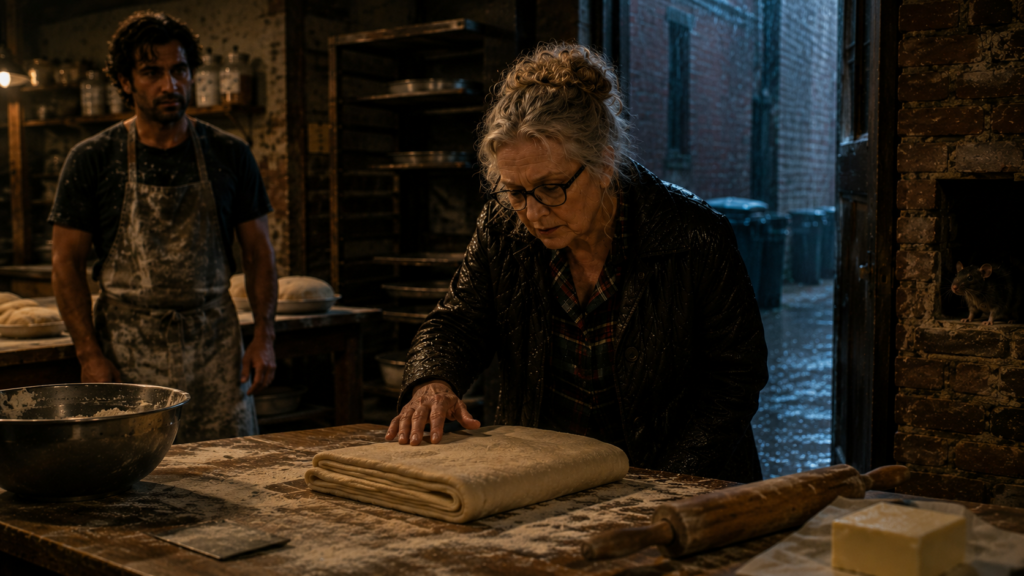
Frances leaned over it. And here, for the first time, she went quiet. She looked at the layering along the cut edge the way other people look at a photograph of someone they used to love. She touched nothing.
“Where did you learn to laminate.”
“Nowhere. YouTube and ruining about two hundred pounds of butter.”
“Hm.” She sat back. “Your lamination is better than your bread. Your lamination is nearly good. Your bread is a man showing off; your croissants are a man paying attention. Do you see the difference?”
“No.”
“Yes you do. You’re just annoyed I said it.” She was right, and worse, she knew she was right, and worst of all she’d stopped being unpleasant about it for one sentence, which was somehow harder to take than the insults. “The bread you make to prove something. The croissants you make because you love them. It’s all over the work. I could taste the difference blindfolded and so could you.”
He didn’t say anything. He rotated the tray a quarter turn it didn’t need.
“The proof, by the way, is running long on those.” She nodded at a rack by the wall. “Warm room. They’ll over-prove and collapse and you’ll blame the flour.”
He checked. She was right about that too. He moved the rack without comment, and she watched him do it with the small satisfied stillness of a woman whose entire retirement had just been justified.
Gerald
That was when Gerald chose to make his entrance, ambling out from the gap in the brickwork with the unhurried confidence of an owner touring his property.
Frances saw him. Frances went rigid.
“There is,” she said, very evenly, “a rat.”
“That’s Gerald.”
“You have named the rat.”
“He was here before I was. He’s got tenure.”
“I will have this building fumigated. I will have inspectors here by—” She stopped. Gerald had paused mid-alley, sat back on his haunches, and regarded her with a flat, ancient calm, entirely unbothered, the look of a creature who had outlasted three previous bakers and would outlast this one and possibly her. Something passed between them. A recognition, professional to professional.
Frances lowered her pointing finger.
“He has been here longer than you,” she conceded, grudgingly, as though this were a legal matter and Gerald had produced documents. “Fine. He stays in the walls. If I find him on my stairs we are having a different conversation.”
Ten to Seven
The rain thinned around six-forty. Somewhere upstairs, apparently, was a spare key with a neighbor Frances could now, in daylight, go and retrieve without dying of exposure.
She stood, and gathered her sodden coat around the tartan, and made it three steps toward the back door before she stopped at the rack of croissants, now fat and glossy and ready.
“When those come out,” she said, not turning around, “the ones on the left proofed longer. They’ll be better. Save me one of the left ones.” A beat. “I’ll pay for it. I’m not one of these people who thinks owning the building means eating for free.”
“It’s on the house.”
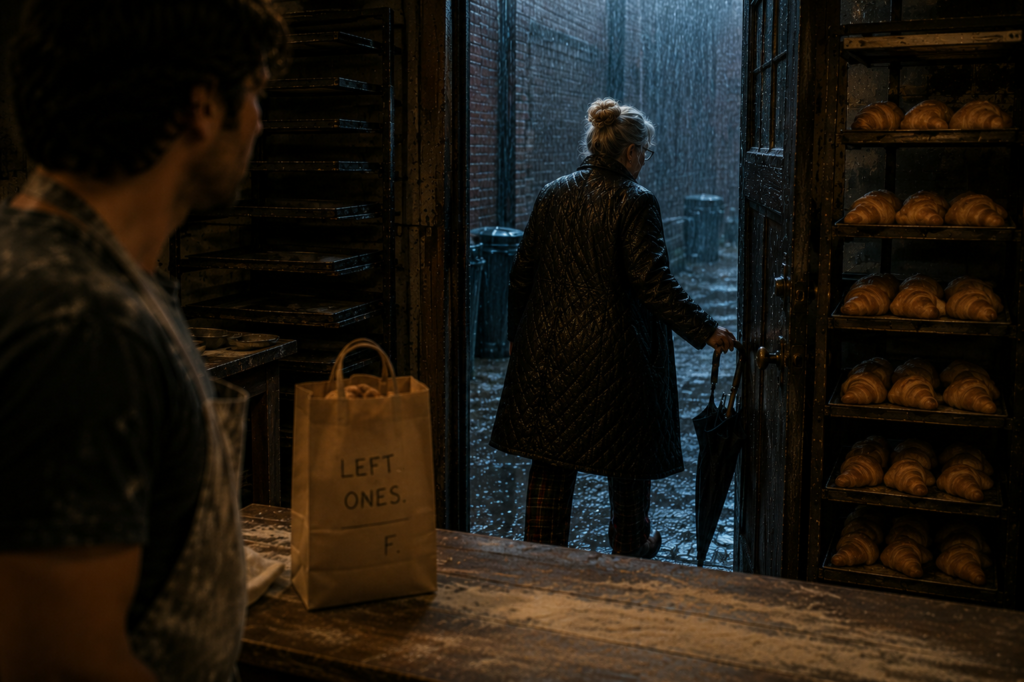
“It is absolutely not.” She was already at the door. “I’ll be down at seven. Don’t let the boy at the front sell my croissant.” And then, with a glance back at the gap in the brickwork: “Morning, Gerald.”
The door swung shut behind her. Nadia came through from the front, wiping her hands, staring at the space where the landlord had been.
“Left ones,” Ismael said, and reached for the oven mitts.
