You Look Like a Coat Hanger
Two Hundred Dollars
The cards stopped working on a Tuesday. Julian found out at the espresso place on Forty-Fifth, where he’d ordered the way he always ordered, and the kid behind the register ran the card twice and then turned the little screen around like Julian might want to see the word DECLINED for himself. He had a five in his wallet. He paid with that and didn’t leave a tip, which he felt bad about for a block and then stopped thinking about because he had bigger problems.
His father had said it the night before, over dinner, and Julian had assumed it was theater. Richard Vance liked a moment. He’d set down his fork and said something about Julian needing to learn what a life actually cost, and Julian had nodded along the way you nod at a man who signs the checks, and then there’d been wine and somebody changed the subject. He’d gone to bed thinking nothing of it.
In the morning there was no breakfast. The housekeeper, who had known him since he was nine, handed him a folded piece of paper and wouldn’t look at him, and that was how he knew it was real before he even read it. Two hundred dollars in twenties, paper-clipped to a note. People will make sure you stay safe. The rest is yours to figure out.
He read it twice. He didn’t understand the part about staying safe. He understood the two hundred dollars, which was sitting in his hand and was apparently all of it.
He was twenty-three and he had never once in his life looked at a price tag and felt it mean anything.
Math
The first month was the math. He’d been braced for the apartment to be the hard part — a studio over a laundromat on a street where the buses ran all night, a radiator that banged like someone was in the pipes with a wrench — but the apartment he got used to. What he couldn’t get used to was that everything was a number, and the numbers added up, and when they added up to more than he had, that was the end of it. There was no second column.
Eggs were a number. Bread was a number. A bag of rice that he figured would last was a number, and it did last, longer than he expected, and he ate a lot of rice that month. He learned to walk past the coffee place without slowing down. He learned the library stayed warm until six and nobody made you buy anything, and that the afternoons in there were full of people doing exactly what he was doing, which was getting through the day for free.
He found work at a used bookstore three weeks in, a narrow place jammed between a key-cutting shop and a pho restaurant in one of the older parts of town. The owner was a man named Doyle who needed someone to shelve and didn’t ask many questions. The pay was nothing. But that first Friday, when Doyle counted the bills out of the register and folded them into Julian’s hand, something happened in his chest that he had no word for. He had made that. It was the first money he’d ever held that hadn’t come down to him through some pipe his father had built.
He took part of it to the pho place next door and ate a bowl slowly, and the broth was the best thing he had ever tasted, and he understood for once why people said that about food you’d worked for. He’d thought it was a thing people said to feel better. It wasn’t.
Cookies
There was an old woman at the shop named Florence who’d been there eleven years and ran it the way some people run a kitchen, knowing where everything was without looking. She was past seventy, small, round, always in a cardigan, and within a week she’d decided Julian was too skinny and that this was a problem she was personally going to handle.
She brought cookies. Oatmeal one day, chocolate chip the next, ginger snaps when the cold came in off the water. She never made anything of it. She’d put a small paper bag on the counter by his elbow and say “Eat those before you go, you look like a coat hanger,” and go back to fixing the poetry shelf, which somebody was always disordering.
He came to want those afternoons more than he could explain to himself. Florence told him about her husband, a ferry captain, dead now, who’d proposed to her out on the water with a ring he’d had no business affording. She told him about her daughter moving back home after Florence’s knees started to go. She never once asked Julian where he’d come from, and the not-asking was the kindest thing anyone had done for him in a year. To her he was just Julian. Showed up on time, good with the customers, ate his cookies. Nobody’s heir. Nobody’s son.
Rain
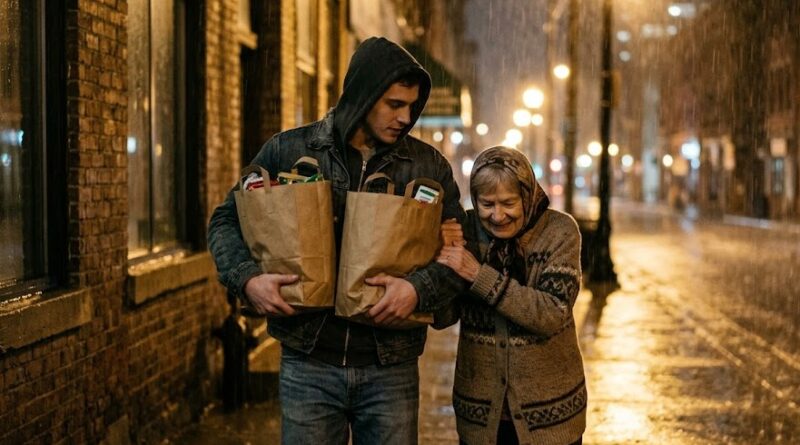
The rain that evening wasn’t the drizzle the city was known for. It came down in sheets, gutters running like creeks, the streetlights smeared into long gold streaks on the wet street. They’d just locked up when Julian saw Florence by the door frowning at four fat grocery bags she’d picked up on her lunch.
“You’re not carrying those home in this.”
“I’ll manage. I always manage.”
He was already taking them off her. “Which way.”
She argued the whole first block and then quit, hooking her arm through his. It took a quarter of an hour, the rain going straight through his jacket to the skin, both of them laughing at what they must’ve looked like. Her house was a small, cared-for thing on a quiet street, flower boxes under the windows, a porch light burning yellow against all that gray.
“Come in. I won’t hear no. There’s pie and you’re not walking back in this till you’ve had something hot.”
He was halfway into a polite refusal when the door opened from the inside.
Doorway
The young woman standing there had brown hair pushed back from her face and the slightly anxious look of someone who’d been watching the window for a while. She had a mug in both hands.
“Mom, finally, I was about to call.” Then she saw Julian on the porch, dripping, holding four grocery bags, and her face shifted into something warmer and a little amused.
“This is Julian, from the shop,” Florence said, stepping in and shaking out her coat. “He wouldn’t let me carry them. Practically took them off me by force.”
“That tracks. She’s the most stubborn woman in the state.” The daughter smiled, and there were dimples. “Thanks for getting her home. Come in, you’re soaked, let me find you a towel before you catch something.”
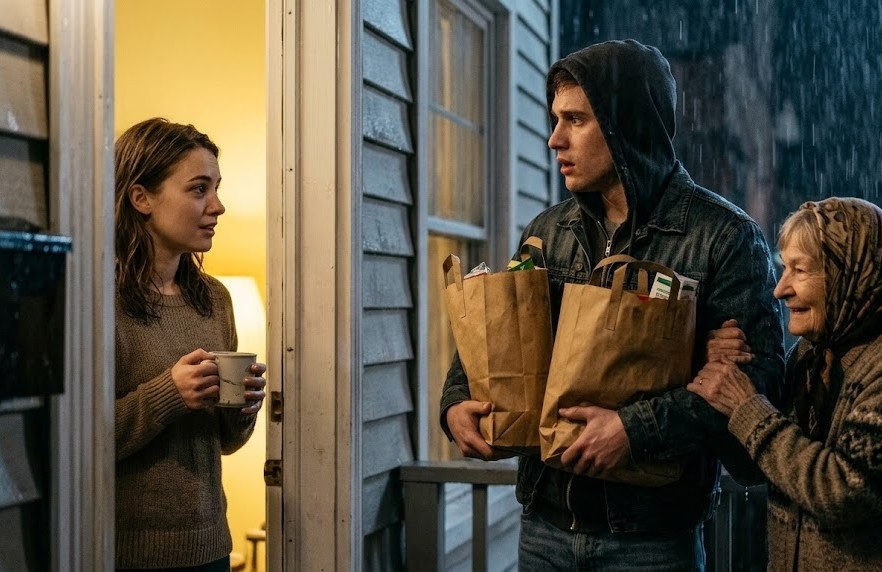
That was it, more or less. Julian had stood in rooms full of women in dresses that cost more than this whole house, and not one of them had ever made him lose the thread of a sentence. But standing on that porch in his ruined jacket, looking at a girl in a knit sweater holding a chipped mug of tea, he forgot entirely what he’d been about to say. He went in.
What He Didn’t Say
They talked past midnight that first night, at the kitchen table, while Florence dozed in her armchair. Books first, then everything else. Her name was Nora. She was training to be a speech therapist and worked part-time at a clinic for kids. She had opinions about music and laughed with her whole face. Julian told her things he’d told no one, except the one thing he kept folded up and put away.
He didn’t tell her about the estate. Didn’t tell her about the money sitting frozen in a bank across town, or the father who was, probably, that very night reading a report on where his son had spent the evening. He wanted to be known as the person he actually was and not the number stapled to his last name. So he let her think he was a clerk at a used bookstore with a small apartment and a careful budget, because in every way that mattered to him now, that was just the truth.
The months after were the best of his life, and it wasn’t close. He and Nora fell into cheap dinners and long walks and Sunday mornings reading at opposite ends of Florence’s couch. He kept the job. He kept the apartment. He learned to fix his own faucet when it dripped and saved what he could and felt, for once, like a man living inside a life he’d built instead of one that had been handed down to him in a box.
Drive Out
It was Nora who finally got him ready to tell it. Not by pushing — she never pushed — but because one evening he watched her on the phone helping one of her kids sound out a hard word, patient, three or four tries, and he understood that he didn’t want one single thing standing between them anymore.
So he asked her to dress up and didn’t say where they were going. He drove them out of the city while the buildings gave way to long stone walls and iron gates, and he watched her get quieter and quieter as the house came up at the end of the drive, lit like a set.
“Julian. Where are we.”
“My father’s house. There’s something I should’ve told you a long time ago.”
His father was in the doorway. He’d aged in the year, gone a little soft in the face, the hard set of his mouth loosened as he watched his son come up the steps standing straight with a woman’s hand in his. He didn’t say anything clever. He pulled Julian into a long hug and held on, and over his son’s shoulder he said, low, that he’d seen what he wanted to see, that Julian had done it on his own. Julian let himself be held and didn’t say much back, because there wasn’t a clean thing to say.
Home
Nora was furious for about a week, which Julian thought was completely fair. She’d fallen for a guy who shelved books, and now there were gates and stone walls and a name she’d seen on buildings downtown. What settled her in the end wasn’t the apology and it wasn’t the explanation. It was that nothing about him actually changed. He still fixed his own faucet. He still worked his shifts at the shop because he wanted to, and still walked Florence home whenever the weather came in bad off the water.
They got married the next spring, a small thing in Florence’s backyard, under the porch light where they’d met. His father came. So did half the shop’s regulars. Florence cried through the whole ceremony and kept saying she had something in her eye.
Years on, when people asked Julian what had turned his life around, they always wanted the story about the money, or the lesson, or his father’s big experiment. He never told it that way. He’d just say it came down to a hard rain and a few bags of groceries, and shrug, and change the subject before anyone could make it into more than that. Then he’d ask if they wanted another drink, and usually they did.
