“Bread That Doesn’t Keep”
Wren Lane
Teodor pressed his back against the bricks behind the bakery because they stayed warm into the evening. He had figured that out on the second day. The ovens sat on the other side of the wall, and the heat came through the stone, and if he sat in the doorway alcove with his knees up he could stop shaking for an hour or two before the cold took it back.
He counted streetlamps because there was nothing else to do with his head. Eleven between the bridge and the lane. He counted the cobbles too, forty-two on the diagonal, and the days since he’d eaten something he hadn’t pulled out of a bin behind the fishmonger’s. Six. He kept the count the way other boys his age kept marbles, turning it over, checking it was still there.
He was not begging. He wanted that on the record even though no one was keeping one. He was sitting where it was warm. A man had told him to move on twice already that week, once with a boot, and he had moved, and come back when the man was gone, and sat down again in the warm spot like a dog returning to a place that smelled right.
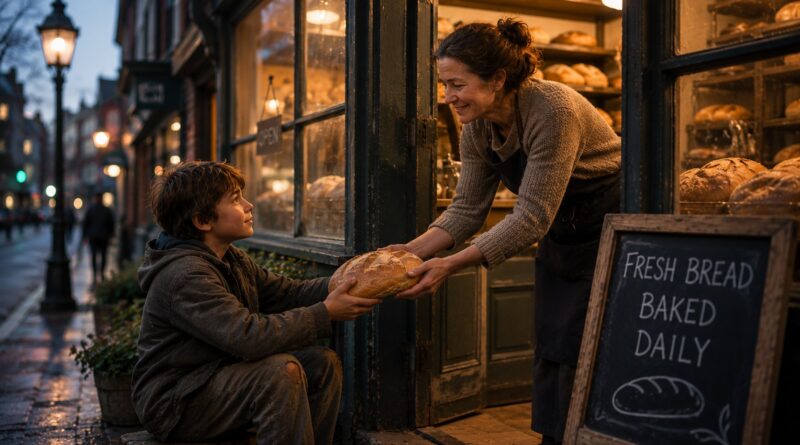
The door opened and the light came out yellow across the wet stones, and with it the smell of the bread, which was almost worse than the hunger because it gave the hunger a shape.
The Baker
He’d watched her through the glass for three days. She was heavyset and fast, flour up to her elbows, the kind of busy that didn’t lift its eyes. He’d decided she hadn’t seen him and he’d been glad of it. Being seen meant being moved.
She crouched in front of him with a loaf in her hands. Her knees popped going down. Up close she had a broad red face and lines at the corners of her eyes and she smelled like yeast and woodsmoke.
“You’ve been out here since Tuesday,” she said. It wasn’t a question and it wasn’t soft. It was just something she’d noticed and was now saying. “Figured you’d have knocked by now.”
He didn’t answer. His pride was the only thing he had that nobody could take, so he held onto it stupidly, the way the starving hold onto things.
“Can’t sell this.” She turned the loaf over. There was a crack along the bottom of it. “Split. Goes to the gulls otherwise. You’d save me carrying it out.”
He found out a long time after that she’d put the crack there herself, with her thumb, in the kitchen, before she came out. So the thing she said would be true. But he didn’t know that yet. He looked at the bread and he looked at her face and there was none of the sourness in it he’d come to expect from people who gave you things. He took the loaf in both hands. It was hot enough that he nearly dropped it.
“There’s a step round the back,” she said, getting up, one hand on the doorframe. “Out of the wind. Oven wall. Warmest spot on the street.” She stopped at the door. “I open at five. There’s usually bread that doesn’t keep.”
The door shut and the light went with it. He ate the bread in small bites to make it last and watched his breath go white in front of him and counted the lamps down the lane until his eyes wouldn’t focus.
What There Always Was
He came back. Not every day. Some days the pride won and he went hungry somewhere else out of spite at no one. But most days.
There was always bread that didn’t keep. He worked out what that meant and didn’t say anything, because saying it would have broken whatever it was. A baker who ran out of unsold bread four days running and still produced, every single time, one loaf with a flaw that only she could find. He never named it. He’d learned that some things only work if you leave them alone.
She got things out of him in pieces. His name in March, like handing over a coin he couldn’t spare. Teodor. He was eleven; he’d said fourteen the first time and she’d let it stand for a month before she stopped pretending to believe it. His mother had died in the autumn. There hadn’t been anyone since. He could read, which surprised her. He counted things when he was scared, and she caught him at it once, lips moving, and didn’t say a word.
She didn’t try to fix him. He understood that part much later, when he understood anything at all. She didn’t send for the parish, which in those years was a slower way of dying. She didn’t make him into a cause she could tell people about. She made him bread, and she made the back step his, and one night in February she left the rear door unlatched and didn’t mention it, and after a while the step became the storeroom floor, which had the oven wall on one side, and nobody ever said out loud how that had come to happen.
By summer he was sweeping. By the next winter he was hauling flour sacks she pretended were too heavy for her, which was a lie they both kept up because it gave him something to do that looked like work and not like charity. By fifteen he could shape a loaf that didn’t embarrass the window. The customers knew his face. The question of where he slept had answered itself so quietly that no one noticed it had ever been a question.
She never told him she’d saved him. She’d have hated the word. When he thanked her once, sixteen and clumsy about it, she said, “You earn your keep. I run a shop, not a mission.” It was the kindest lie anyone ever told him.
Leaving
He left at twenty. She pushed him out herself, put money in his hand she called back wages, which was another lie, and found him a place with a baker in the capital who owed her something from years back.
“You’re wasted on one window,” she said the morning he went. She didn’t cry. Her chin did a thing it did when she wouldn’t. “Go on. Send a card now and then so I know you’re not drowned.”
He sent cards. For a while.
Then the years happened to him the way they happen to everyone. A shop of his own, eventually, on a decent street. A wife, Annika, who laughed at the counting and then started doing it with him under her breath when she thought he wasn’t listening. Two children. The long stretch where you mean to go back and don’t, where you think of someone almost every day and somehow never put pen to paper, where the cards thin out to a line at Christmas and then to nothing, not because the feeling cooled but because a full life has its own weight and it pins you where you are.
He meant to go back. He always meant to.
November
The letter came from the niece. She’d tracked him through the guild. She’s failing, it said. She won’t ask for anyone. But she keeps your old cards in a tin by the bed and gets them out. I thought you’d want to know.
He went up on a grey afternoon with the cold coming off the river. The shop was still there. Same window. Same chalkboard, different handwriting. He stood across the square longer than he meant to and counted the cobbles on the diagonal without deciding to, forty-two, and his eyes stung, and he told himself it was the wind.
A young woman was behind the counter with something of Maren in her shoulders. She came around before he’d finished saying who he was and took both his hands in hers, which were floury, and told him to go up, the stairs at the back, that she was slow now but still herself.
Upstairs
Maren was small in the bed by the window. The years had taken more off her than they should have been allowed to. But her eyes were the same and they found him in the doorway and went bright.
“Look what washed up,” she said.
He sat where she could reach him and held her hand. It was thin and the strength was gone out of it but it was still warm. The tin sat on the sill with the lid open. He could see his own younger writing in there, faded.
“I should’ve come back,” he said. “I’m sorry. I kept meaning—”
“Stop that.” Her fingers closed on his as hard as they could, which wasn’t hard. “You went and made something. That’s what I told you to do. I’ve read the guild notices twenty years. I know about your shop.” She paused, and the chin did its thing. “I know about the doorway. The boys who sit in it. I’ve heard what you do.”
He looked at her. He had never told her that. He’d never told anybody the shape of it, the loaves with the cracks he put there himself, the back step left open, the latch he forgot on purpose.
“I learned it somewhere,” he said.
“You learned it nowhere. You’re a baker. You run out of unsold bread. Not your fault if it keeps happening.”
She didn’t smile and tell him the debt was paid. She closed her eyes for a while and he thought she’d gone to sleep, and then she said, without opening them, “There’s bread that doesn’t keep in the kitchen downstairs. Tell Edda I said to send some up. I can’t taste much anymore but I like the smell.”
He went down and told the niece. Edda. He said her aunt wanted bread sent up for the smell of it, and Edda nodded and put a loaf on a board and didn’t say anything, and her eyes were wet and she didn’t wipe them.
He stayed three days. He shaped bread in the old kitchen the way he’d been taught in that same room, and the place smelled the way it always had. On the second evening he went out front for the air and there was a thin boy in the alcove where the bricks held the heat, knees up, watching the door.
He didn’t ask the boy anything. He went back inside and found a loaf and put a crack in the bottom of it with his thumb. Then he stood at the counter a moment with it in his hand, because his back was stiff from the bench and the stairs, and he called to Edda to ask where she kept the paper bags.

This is awesome ! Should have been posted by itself so it could be shared forever !