Twelve Cars and Nobody in Charge
The Access Road
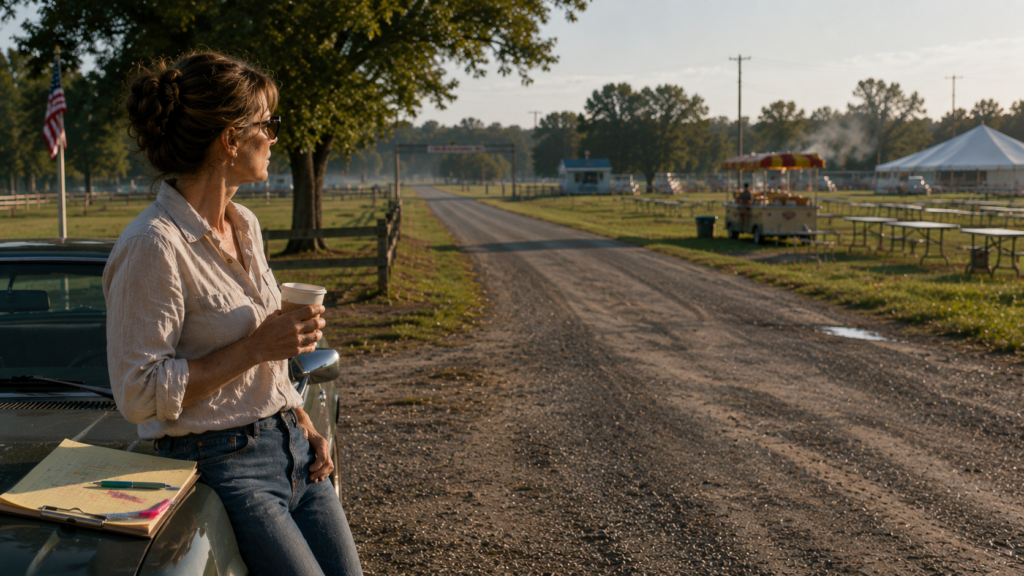
Harriet had the exhibition mapped on a legal pad in three colors, which was two more colors than the job needed, and she knew that, and she’d done it anyway. Twelve cars. One turn. Down Bellamy from the co-op lot, right at the savings bank, out the county road to the fairgrounds where the folding tables were already up and the hot dog cart was already smoking and a kid from the 4-H was already asking her where the bathrooms were.
It was not a parade. She’d said that to the council twice and to her husband once and mostly to herself, because a parade meant road closures and a certificate of insurance and a fight about the marching band’s amplifier that she was not going to have again. What she’d organized was cars driving to a field. The cars had to get to the field. That was the whole of it.
She stood at the mouth of the access road with a paper cup of gas station coffee going cold in her hand, waiting for the sound of a dozen engines that were old enough to be heard before they were seen.
Nine o’clock came. No engines.
Nine-fifteen. Still nothing.
The Fork
The trouble was Felix, and the trouble with Felix was that he’d lived in town five weeks and drove like a man who’d been told the streets ran in a grid and believed it. He was out front in a red ’62 convertible he’d rebuilt himself, and where Bellamy split at the savings bank he went left, into downtown, instead of right, toward the field.
Eleven cars went left behind him. Not one driver flagged him down, because he was in front, and being in front is its own kind of credential. Nobody wants to be the man who honks at the leader and turns out to be wrong.
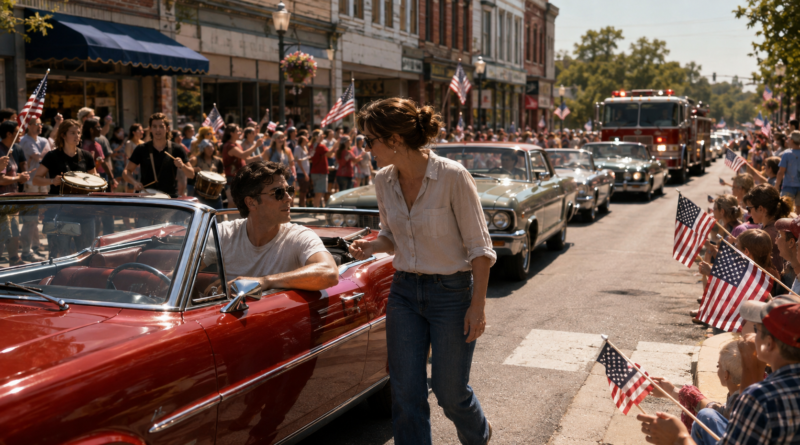
So the line came down Center Street at a walking pace, chrome and whitewalls and a lot of hand-waxed paint, sliding past the pharmacy and the shoe repair and the café on the corner where a busboy was hosing down the sidewalk. He turned the hose off to watch.
The Horn
A kid on the curb waved. Four, maybe five years old, up on his toes with his hand going like he was trying to signal a plane. Felix didn’t know why the kid was waving but tapped the horn back, because it would’ve been rude not to. One short honk.
The second driver took the honk to mean something and honked too. Then the third. By the fifth it had turned into a thing that was occurring rather than a thing anyone had decided, and the noise brought people out of the businesses to see who’d died or gotten married.
Three teenagers were doing nothing outside the music store, which is the main thing there is to do outside a music store, and one of them had a practice pad and sticks from a lesson. He started a cadence. The other two took a djembe off the sidewalk display the owner would later claim he’d been meaning to move, and fell in behind the cars, and now there was drumming.
Downtown
Somebody at the café remembered a box of little paper flags in the back from two Fourth of Julys ago, and a waitress went down the line of the curb handing them out, and people took them and waved them, because a flag in your hand and cars going by does the rest of the work itself. No one asked what the occasion was. The occasion was that it was happening.
Gus was on shift at the station, and Gus was a serious man about a serious job. He came out and saw a slow column of vehicles, a drumline, and two hundred people packed along both curbs waving flags, and he arrived at the only conclusion the situation offered: town hall had scheduled something and forgotten to loop in the fire department, again, which was exactly the kind of thing town hall did. He backed the engine out of the bay and eased it onto the tail of the procession to manage the crowd he assumed was about to become a hazard.
An engine with its bar lights turning, rolling at two miles an hour.
That was the part that settled it. Up to then it had been confused men in old cars. With a fire truck behind it, it was a parade, and everyone downtown now understood themselves to be either in it or watching it.
The Phone Call
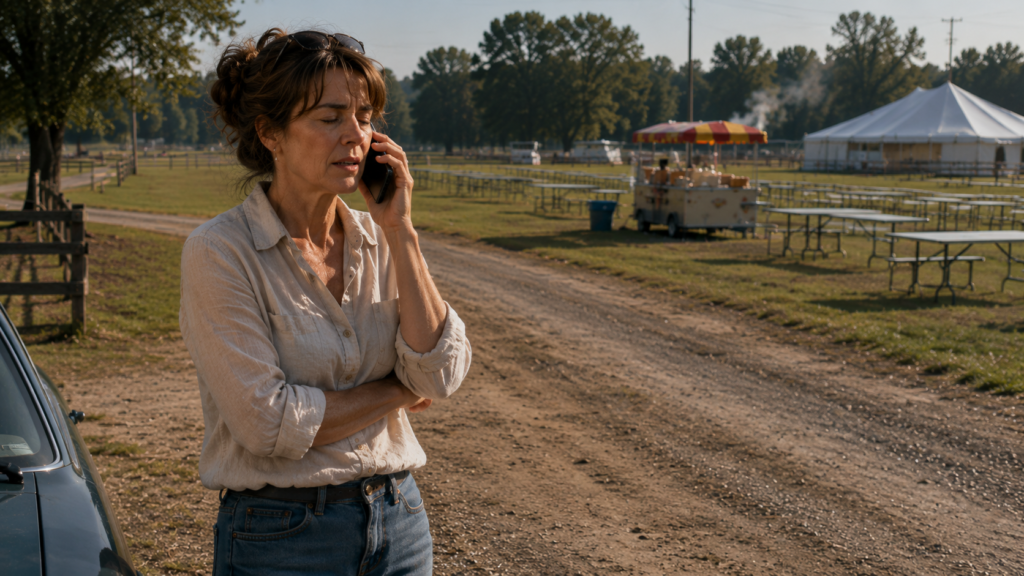
Harriet’s phone went off in the empty field where she’d been standing for the better part of an hour cataloging disasters. Pileup. Bad address. Twelve carburetors quitting at once. She’d about talked herself into the idea that the whole club had bailed when the screen showed the bookstore.
“Harriet. This is unbelievable.”
“What is.”
“The parade.”
She shut her eyes. “What parade.”
There was a pause, the particular pause of two people looking at two different mornings.
“The one you’re running,” the bookstore owner said. “On Center. There’s a fire truck in it.”
She didn’t say goodbye. She put the coffee on the roof of her car, forgot it there, and drove.
She smelled it before the road showed it to her — popcorn and exhaust and the warm crowd smell of a lot of bodies close together in the sun. She turned onto Center and stopped, because there was nowhere to put the car. The street was full. Kids on shoulders. A man leaning out of a ’57 pickup dropping candy to the curb. The teenagers soaked through and still going. Flags the whole length of the block. And out ahead, at his stately two miles an hour, Felix, lifting a hand to a crowd that had appointed him grand marshal of a thing that did not exist.
She left the car running against the curb and walked up alongside his door on foot, keeping pace.
“You took the wrong street,” she said.
Felix looked over. “I know.”
“So why are you still driving it.”
He tipped his head at the sidewalks, the flags, the drummers, the kid who’d started it now riding his father’s neck and screaming every time a horn went. He didn’t say anything clever. He said, “Where do you want me to turn.”
She looked at the field on her legal pad, the field that had ordered enough hot dogs for eighty and was about to meet several hundred. She looked back at the street.
“County road’s two lights up,” she said. “Bear right this time. Just this once, right.”
“Right,” Felix said.
She got the officer she’d gone to high school with on the phone and gave him ten minutes and a route. Then she walked back to her own car, which was still idling where she’d left it with the door open, and she reached in and shut the engine off, and stood there a second in the noise doing the arithmetic on how many more packages of buns the co-op had in stock and whether anyone was answering the phone there on a Saturday.
