Nine Minutes at Mile Marker Fourteen
How a Corporate Tower’s Reflection Broke a Highway Every Autumn
The ticket had been kicked back to Nadia’s queue twice already, stamped “no infrastructure defect found,” and she was starting to understand why nobody wanted it.
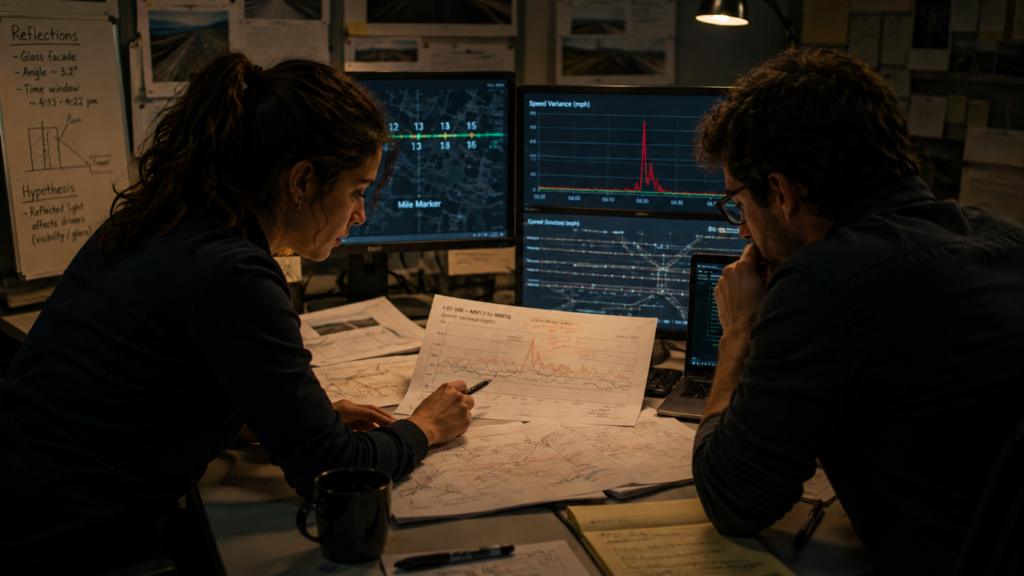
She tapped the monitor with the capped end of her pen. The red line on the graph shot up at 4:14 in the afternoon, a sharp aggressive peak that fell into a messy, jagged plateau before it recovered. Same thing on the printout beneath it. And the one under that.
“There’s nothing there,” she said, more to the screen than to anyone. “No on-ramp for two miles. No lane drop. Surface got repaved in May, so it’s not potholing. But every Tuesday and Thursday, late October, westbound falls off a cliff. Sixty-five down to twelve. Nine minutes, then it’s gone.”
Rylan rolled his chair back from the next desk. He modeled traffic the way a hydrologist models a river — flow and pressure and volume — and he had an answer ready before she’d finished.
“Phantom jam. Somebody taps the brakes, the driver behind overcorrects and brakes harder, the wave propagates backward up the line. Textbook shockwave. You don’t need a cause at the front, just one unlucky twitch.”
“I know how a brake wave works,” Nadia said, and dragged a second overlay of the highway grid onto the screen. “But a brake wave still needs something to start it. A squirrel, road debris, somebody looking at their phone. Those are random. They don’t schedule themselves. This is the same spot, mile marker fourteen, the same two weekdays, the same nine minutes of the same afternoon. Random doesn’t keep a calendar.”
That was the part that had made two other engineers hand it back. A phantom jam explains a jam with no cause. It doesn’t explain a jam with no cause that shows up by appointment.
Reading the Loops Buried Under the Asphalt
They spent the next three hours pulling raw counts off the induction loops — the electromagnetic coils set under the road surface that register a vehicle every time metal passes over them. The loops confirmed the anomaly with almost insulting precision.
At 4:14 the lead vehicle in the westbound lane would brake hard. Within sixty seconds a wall of braking cars stacked back a mile and a half. By 4:23 the front of the pack was accelerating again and the whole jam dissolved as fast as it had formed, as if it had never happened. The signature was identical every time it appeared:
- No collisions logged by highway patrol on that stretch, ever, across the entire pattern.
- No stalled or disabled vehicles called in during any of the events.
- Repaved surface from May, which ruled out potholes, buckling, and seam damage.
- Cameras dark in that exact sector, pulled offline for a scheduled network upgrade.
That last one was the real problem. The municipal cameras covering mile marker fourteen were down for the upgrade, which left the department blind to whatever was physically happening on the ground. They had beautiful data describing the jam and no way to see the thing causing it.
Nadia printed the speed-variance charts and spread them across the drafting table. Traffic engineering is mostly a science of volume and capacity — retiming signals to swallow a rush-hour surge, redesigning a merge to smooth the flow. Chasing a scheduled phantom jam through a sector with no eyes on it was a different kind of work. You couldn’t model your way to it. You had to go stand where it happened.
Standing on the Overpass at 4:10
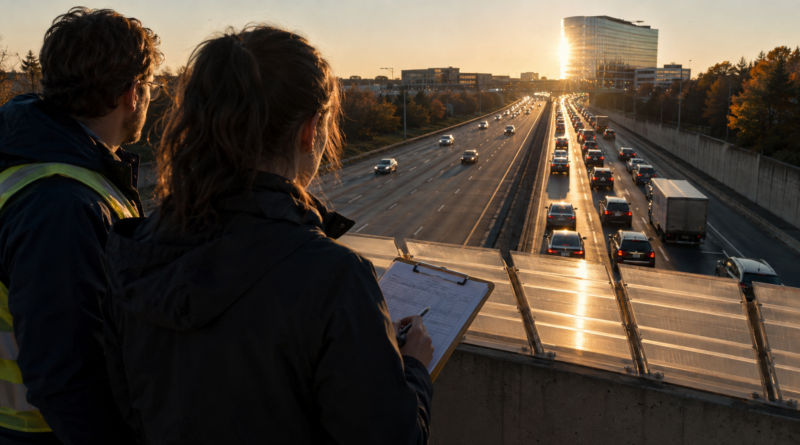
Thursday afternoon they drove out to the concrete pedestrian overpass that crosses Highway 61 near the marker. They brought a radar gun, a light meter, a notebook, and not much of a theory.
The air was sharp and the low late-October sun sat well down the sky, throwing long hard shadows across the barriers. At four o’clock the westbound lanes were running clean, an unbroken stream of commuters pushing out past the city line.
“Four-ten,” Rylan said, checking his watch and marking the clipboard. “Flow’s optimal. Averaging sixty-four.”
Nadia kept her eyes on the horizon. The highway ran dead straight ahead, flanked by a thin line of oaks and, off to the south, a commercial district that hadn’t been there two years ago.
At 4:13 the light changed. Not gradually. All at once.
The sun dropped below the roofline of a distant office park, and a concentrated beam caught the curved glass front of a newly finished corporate tower to the south. The reflection threw itself across the open ground, cut straight through the shadows, and landed on the westbound lanes like someone aiming a spotlight.
The Building Was the Trigger
Nadia got her clipboard up in front of her face on reflex. Down on the road a silver sedan drove straight into the patch of reflected glare and the driver, blinded, hit the brakes. Brake lights flared. The delivery truck behind braked harder to stay off the sedan’s bumper. The SUV behind the truck nearly locked its wheels, tires chirping on the asphalt.
Within thirty seconds the fast clean motion of the highway seized into a bumper-to-bumper crawl.
“There’s your trigger,” Rylan said, staring at the far-off tower. “Glare geometry. The sun only hits that curved facade at this angle this one week of the year, at this elevation, right as it drops past the office park. Wrong week, wrong angle, no reflection. That’s why it’s seasonal.”
Nadia wrote down the time. 4:14. Dead on.
They watched the jam ripple backward up the line while the planet kept turning and the sun’s angle crept off by fractions of a degree. At 4:23 the reflection slid off the road surface, climbed the concrete retaining wall, and left the lanes in ordinary shadow. Down below, the front drivers accelerated and the whole thing came apart. Nine minutes, start to finish, dictated by the rotation of the earth against one pane of curved glass.
Blocking a Single Angle of Light
The constraints on a fix were obvious and awkward. They couldn’t drop the speed limit for a problem that existed nine minutes a day, two days a week, two weeks a year. They couldn’t order a private company to re-clad a fifty-story building. Whatever they did had to be infrastructural, static, and aimed at exactly one thing — a single trajectory of light hitting a hundred-yard run of road.
Back at the center, Nadia wrote up the proposal for public works, and the surprising part was how cheap it came out. No sound wall, no digital warning boards, no active system to maintain. The whole problem was one angle of light reaching one piece of pavement, and you only had to interrupt that one angle. She kept the recommendation to a few flat lines at the top of the memo:
Proposed remedy: install angled polycarbonate louvers along the southern retaining wall, MM14, 100-yard span. Baffle geometry to diffuse incident glare on the westbound deck while passing crosswind. No lane closure or speed reduction required. Estimated cost minimal.
Within two weeks a maintenance crew mounted a run of angled polycarbonate louvers along the top of the southern retaining wall. They set them twelve inches apart — close enough to catch and scatter the specific path of the reflected beam, open enough to let a crosswind through instead of turning the whole thing into a sail.
Nadia and Rylan didn’t drive out to watch the install. No reason to. They sat at their desks on the first Tuesday of November with the telemetry monitor open and the green speed line running across it.
4:14 arrived. The line held flat at sixty-five. The red spike didn’t come.
Rylan watched it another minute, then turned back to his own screen without saying much. Nadia capped her pen, filed the report in her drawer, and pulled up the data set for the downtown intersection that had been waiting behind this one all week.
